REVIEW · FLORENCE
Florence: Best Of – with Tour Leader & Multilingual Audio Guide
Book on Viator →Operated by ACCORD Italy Smart Tours & Experiences · Bookable on Viator
Florence makes more sense on foot. This 2.5-hour highlights walk keeps you moving through central streets with a small group (max 15) and earphones so the guide stays clear even when squares get loud.
I also like that you get multilingual audio support designed by an art historian, so the explanations don’t feel like they stop when people ask questions or when the group reshuffles. One note to keep expectations grounded: this tour is mainly about quick orientation, with no admission tickets included, so you’ll likely want to plan separate time inside the big museums and churches.
In This Review
- Key highlights worth caring about
- Florence in 2.5 hours: what this tour is best at
- Price and value: $17.54 plus lunch, but not museum tickets
- Meeting point to finish: why the start/end matters in Florence
- Earphones and multilingual audio: the practical advantage
- Stop-by-stop route: Uffizi square to Ponte Vecchio
- Piazzale degli Uffizi (in front of the Uffizi)
- Piazza della Repubblica: arches, carousel, people-watching energy
- Ponte Vecchio: the bridge shops and the history you’ll keep hearing about
- Palazzo Vecchio and Piazza della Signoria: power and sculpture in one square
- Palazzo Vecchio viewpoint: outside power meets clock-tower drama
- Piazza della Signoria: where Florence flexed politically
- Santa Croce and the Bargello: two art stops that reward a second visit
- Basilica di Santa Croce: tombs and frescoes tied to big names
- Museo del Bargello: Renaissance sculpture in a former town hall and prison
- Duomo square to Via de’ Tornabuoni to Pitti area
- Cathedral of Santa Maria del Fiore: dome views and a whole architectural ensemble
- Via de’ Tornabuoni: the elegant city living room
- Palazzo Pitti: power shifts, then gardens and galleries
- The small-group advantage: what to expect from the guide
- What’s included: lunch timing and what to do with it
- When this tour fits you best (and when you should choose another)
- Book it if you want first-day orientation
- Consider skipping or pairing it if you want museum time
- Language and pace are the only real risk points
- Should you book this Best of Florence highlights tour?
- FAQ
- How long is the Florence Best Of tour?
- What does the tour cost?
- Is this tour a small-group experience?
- Is the tour offered in English?
- Will I hear the guide clearly?
- Are entry tickets included for museums and churches?
- Is lunch included?
- Where do I meet and where does the tour end?
- Can I cancel and get a full refund?
Key highlights worth caring about
- Earphones included so you can follow the route without craning your neck
- Multilingual audio content made with an art historian’s input
- Big Florence icons on an efficient route (Duomo area, Ponte Vecchio, Palazzo Vecchio views)
- Lunch included (Florentine schiacciata or a charcuterie board, depending on your option)
- Family friendly feel with a small group size that helps you stay together
- Orientation for first-timers so you know where to return later
Florence in 2.5 hours: what this tour is best at
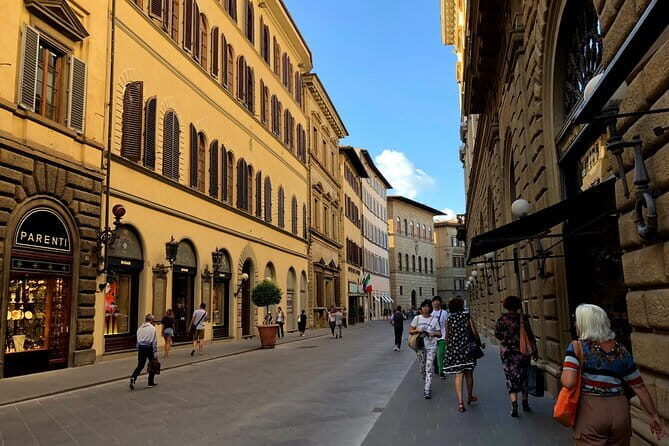
This is the kind of tour you book when you want a clean overview of central Florence fast. You’ll walk through the historic core and hit the landmarks you’re already seeing on postcards—then you’ll leave with a mental map, not just snapshots.
The route is built for movement. Each stop is short (about 10 minutes), which means you get variety—squares, bridges, church exteriors, and palace views—without spending your whole day in one ticket line.
This is also a good match if you like learning with your feet on the ground. Florence can feel like a maze at first. A walking tour like this helps you connect the streets to the stories, so later you can wander confidently.
You can also read our reviews of more guided tours in Florence
- The Best tour in Florence: Renaissance & Medici Tales – guided by a STORYTELLER
★ 5.0 · 12,316 reviews
Price and value: $17.54 plus lunch, but not museum tickets
At $17.54 per person, the value here is mostly in what’s included. You get a professional tour leader, earphones, multilingual audio support, and a lunch component (Florentine schiacciata or a charcuterie board, depending on what you select).
What’s not included is just as important: admission tickets. That means stops tied to major attractions—like the Uffizi area, Palazzo Vecchio, and the Duomo complex—are more about seeing and orienting than doing full museum time.
For planning, think of this as a smart “front-load” tour. You pay for guidance and context now, then you decide later where you want to spend your money and time.
Meeting point to finish: why the start/end matters in Florence
The tour starts at Piazza di Madonna degli Aldobrandini, 8, and ends at Piazza del Mercato Nuovo, near Fontana del Porcellino. That open-ended finish is useful in real life because it drops you in a busy, central area where you can keep exploring on your own.
I recommend you arrive around 15 minutes early so you’re not rushed when people are finding the group. In the center, a small delay can feel huge, because the streets twist and signage can be confusing.
Also, wear shoes that you can walk in for a solid chunk of time. Even though each landmark stop is brief, the walking adds up quickly in Florence’s old streets.
Earphones and multilingual audio: the practical advantage
The biggest “quiet superpower” here is the earphones. Florence is loud in the normal way—traffic, chatter, tour groups—and earphones help you keep the story even when you’re not standing right next to the guide.
The tour also uses multilingual audio contents created by an art historian. That matters because you’re not just hearing facts; you’re hearing explanations that connect art, architecture, and civic life into something you can actually remember.
Still, audio is only helpful if you can use it comfortably. If your earphones aren’t working well, tell the guide early. One annoying moment can make an otherwise solid tour feel frustrating.
Stop-by-stop route: Uffizi square to Ponte Vecchio
You can also read our reviews of more tours and experiences in Florence

Piazzale degli Uffizi (in front of the Uffizi)
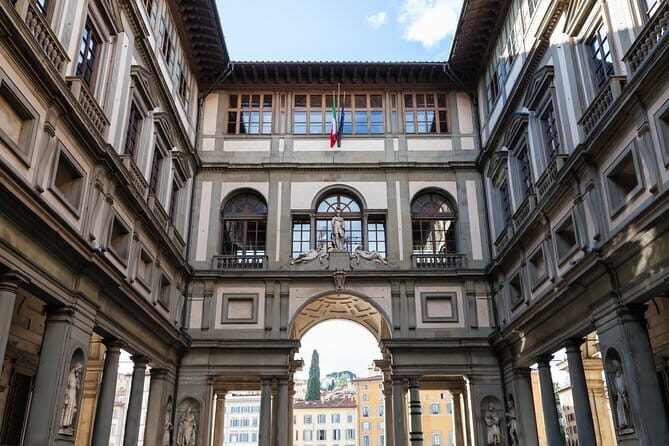
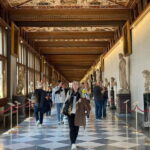
You begin with a classic Florence viewing point right in front of the Uffizi Gallery. This area is a natural warm-up because the square opens your view toward the Arno River and the historic center.
This is a good place to slow down for a second and look. You’re spotting the layers: river, bridges, palace silhouettes, and the way the city climbs.
Admission tickets aren’t included here, so expect to see the gateway vibe, not the museum floor.
Piazza della Repubblica: arches, carousel, people-watching energy
Next comes Piazza della Repubblica, one of the city’s most recognizable squares. You’ll find historic-style arches, cafes, shops, and that old-school carousel feel.
This stop works because it’s a break in pace. After the river-adjacent open space, the square brings you into the thick of the central city rhythm.
Ponte Vecchio: the bridge shops and the history you’ll keep hearing about
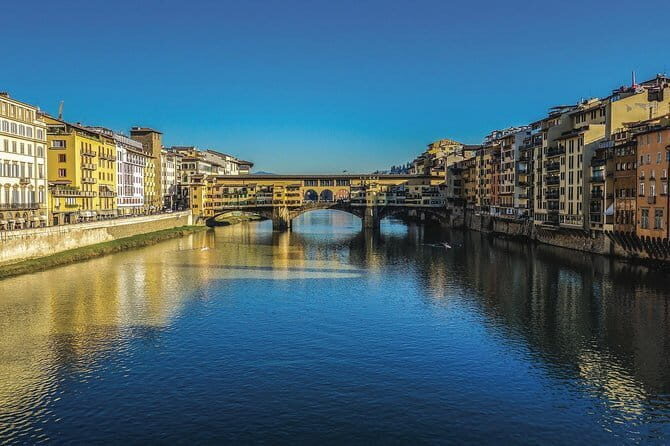
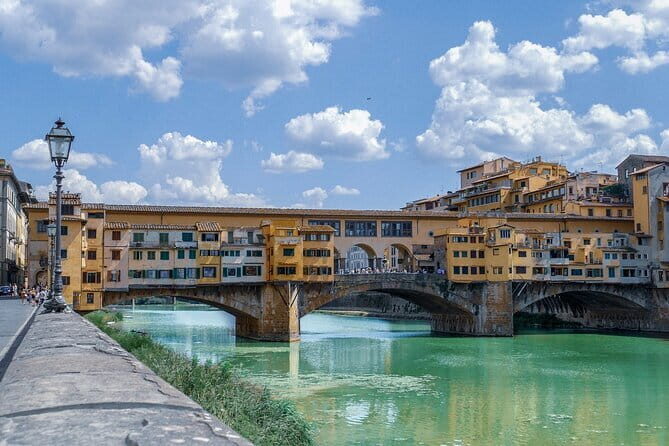
Then you hit Ponte Vecchio, the famous medieval stone bridge over the Arno. Today, it’s lined with jewelry shops, but the bridge began with butchers and fishmongers—so the street-level “what changed, what stayed” theme is built in.
One of the best things to notice here is how survival shapes identity. The bridge is known for enduring major floods and wartime dangers, and that long survival helps explain why it became such a lasting symbol for Florence.
If you catch the right explanation from your guide, you’ll also hear how the Vasari Corridor area relates to the bridge’s history and the shift from butchers to goldsmiths. It’s the kind of detail that makes you see the shops as more than storefronts.
This is a free-admission stop, but it’s still one of your best “wow” moments—because the bridge is both architecture and everyday commerce.
Palazzo Vecchio and Piazza della Signoria: power and sculpture in one square
Palazzo Vecchio viewpoint: outside power meets clock-tower drama
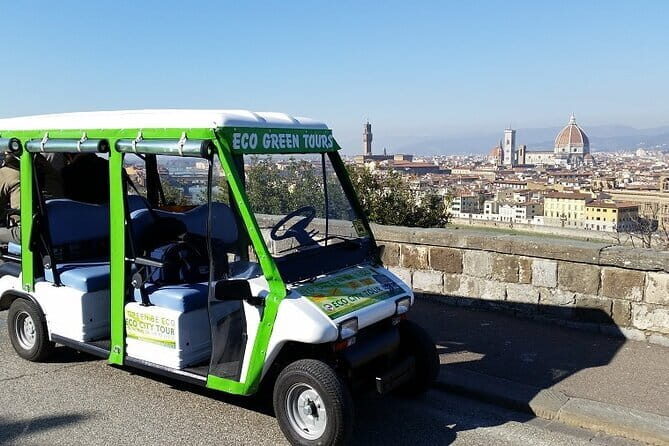
You’ll get an exterior look at Palazzo Vecchio, a fortress-like symbol of Florence’s former civic strength. The façade carries sculptures and decorative details, and the tower clock is a constant visual anchor.
Because entry tickets aren’t included, treat this moment as a photo-and-context stop. You’re learning what to look for so you’ll understand it better later if you decide to enter.
Piazza della Signoria: where Florence flexed politically
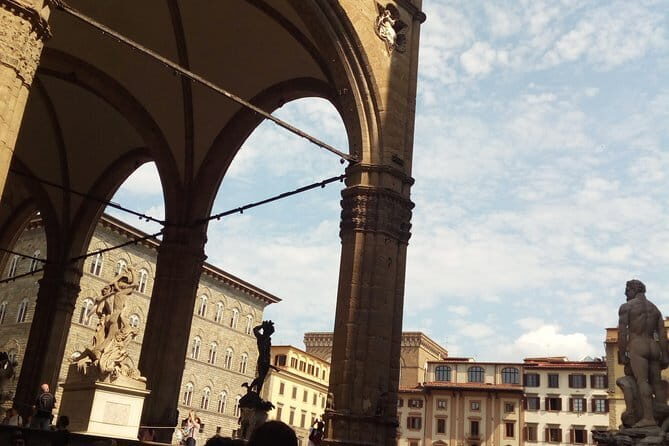
Then you’re at Piazza della Signoria, one of the city’s core historic squares. You’ll see landmarks like the Loggia dei Lanzi and sculptures that help you connect art to public space.
A key detail: this square served as Florence’s political center for centuries. That turns “scenery” into “stage,” which is why guides often spend time here—even on a short stop.
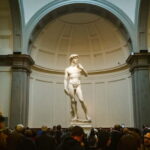
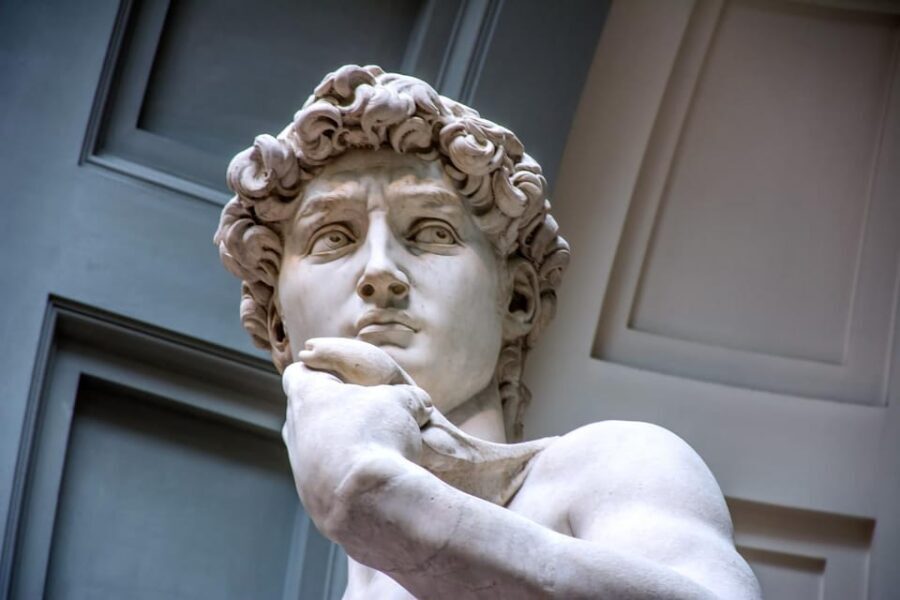
The square is also linked to Michelangelo through a replica of David, plus you’ll find the Fountain of Neptune. Even if you’ve seen the image online, standing in the square changes how you understand scale and placement.
This stop is free to enjoy, and it’s a strong one for first-time orientation. After this, you’ll know how the Duomo area and the surrounding streets relate to the civic center.
Santa Croce and the Bargello: two art stops that reward a second visit
Basilica di Santa Croce: tombs and frescoes tied to big names
Santa Croce is a Franciscan church with Gothic architecture that Florence fans take personally. It’s famous for housing tombs of major figures, including Michelangelo, Galileo, and Machiavelli.
The church is also known for frescoes by artists like Giotto and for its impressive marble façade. Even if your visit here is short, you get a feel for why Santa Croce is one of those “don’t miss” sites.
If you want to go deeper, remember the tour is a walking overview. Admission tickets aren’t included, so you’ll need separate planning for inside time.
Museo del Bargello: Renaissance sculpture in a former town hall and prison
Near Piazza del Signoria, the Bargello is set in a former medieval palace that once served as the city’s town hall and prison. That past matters. It makes the museum feel grounded rather than untouchable.
The collection is known for Renaissance sculpture, including works tied to Donatello, Michelangelo, and Verrocchio. You’ll also find decorative arts like ceramics, textiles, and weapons, which gives the museum more angles than pure sculpture.
For many people, this is the “I’m glad I didn’t skip that” museum. If your time is tight, this tour gives you a taste and a clear reason to return.
Duomo square to Via de’ Tornabuoni to Pitti area
Cathedral of Santa Maria del Fiore: dome views and a whole architectural ensemble
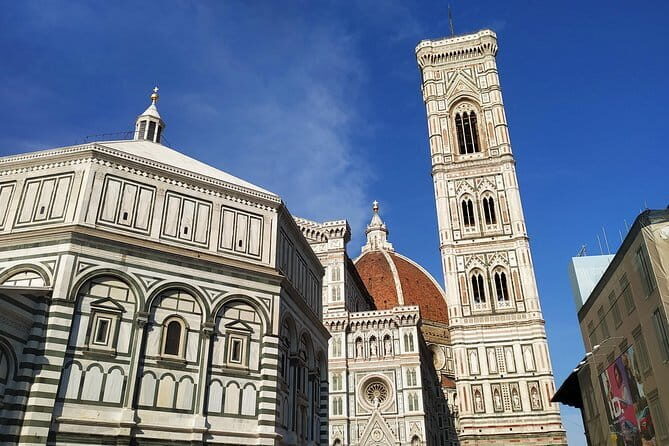
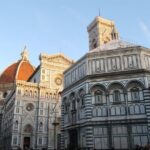
Next up is the Cathedral of Santa Maria del Fiore area. Piazza del Duomo is the huge architectural stage: the cathedral dome designed by Brunelleschi dominates the skyline.
You’ll also be around the Baptistery of St. John and Giotto’s Campanile, which helps you see why this area feels like a Renaissance “set” rather than one building.
Admission tickets aren’t included, so the tour tends to focus on seeing the ensemble, not climbing inside.
Still, standing in the square helps you understand which viewpoints matter and where your photos will come out right.
Via de’ Tornabuoni: the elegant city living room
Then you’ll walk along Via de’ Tornabuoni, one of Florence’s most elegant streets. Since Renaissance times it has been treated like the city’s living room, lined with historic palaces such as Palazzo Strozzi and Palazzo Spini Feroni.
Spini Feroni is especially noted as the home of the Salvatore Ferragamo Museum. And today the street is famous for high-fashion boutiques and jewelry stores, including names like Gucci and Ferragamo.
Even if you don’t shop, this stop is useful. It shows you the other side of Florence beyond museums—where money, design, and architecture share the same street.
Palazzo Pitti: power shifts, then gardens and galleries
Finally, you’re in the area of Palazzo Pitti, a major Renaissance palace. It began as the wealthy Pitti family home, then became the residence of the Grand Dukes of Tuscany, and later the Italian royal family.
You’ll connect Pitti with its big cultural draw: the Palatine Gallery (with works by Raphael, Titian, and Caravaggio) and the Boboli Gardens, a signature example of Italian garden design.
Again, tickets aren’t included, so this tour is about understanding the location and what the palace is famous for. If those names mean something to you, you’ll have a clearer plan for your next visit.
The small-group advantage: what to expect from the guide
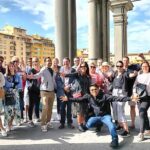
This experience is capped at a maximum of 15 travelers, which is a big difference from the giant-bus style tours. In practice, it means you’re more likely to stay close to the leader, and questions are easier to fit in.
The tour is also family friendly, which suggests the pace and structure are designed for mixed ages. If you’re traveling with kids, that’s a real advantage because you’re not relying on museum patience for the whole trip.
One more thing: some guides are praised for telling stories that make Florence feel human, not just historical labels. Names that have come up in guide feedback include Yaniel, Isabella, Natalia, Remo, and Valeria. You can’t guarantee a specific leader, but the consistent theme is clear: story-first, street-level explanations.
What’s included: lunch timing and what to do with it
Lunch is included as either Florentine schiacciata or a charcuterie board, based on your option. That can be a lifesaver in Florence, where you don’t always want to hunt for food between sights.
Because the tour is about 2.5 hours, you might want to eat before you get too hungry. If you’re the type who needs a real meal early, plan accordingly and treat the lunch as part of your schedule, not a random reward.
Also, keep an eye on any advertised food add-ons. One guest wrote that there was free gelato at the end, while another said the gelato stop was removed from their version. If gelato is on your must-do list, confirm what’s currently included when you book.
When this tour fits you best (and when you should choose another)
Book it if you want first-day orientation
If it’s your first trip and you’re trying to understand where everything sits—Duomo versus Ponte Vecchio versus Palazzo Vecchio—this tour is built for that.
You’ll also be happier with this format if you like short stops and moving on. It’s not a sit-down class. It’s a guided walk with just enough background to make later exploration easier.
Consider skipping or pairing it if you want museum time
If your dream vacation is deep museum visits, you’ll probably want separate tickets and a longer itinerary. This tour doesn’t include admission, and its stop lengths are short by design.
That’s not a flaw—it’s simply a different goal. Think of it as a map with stories, not a full ticketed museum day.
Language and pace are the only real risk points
In a walking tour, you’ll be close to your group and exposed to crowd noise. If you’re sensitive to accents or need very clear audio, test the earphones right away and let the leader know if something feels off.
Also, some people find that the schedule can feel brisk. If you know you move slowly, consider how much walking you can handle comfortably for 2.5 hours.
Should you book this Best of Florence highlights tour?
Yes, if you want an efficient first taste of Florence’s top sights plus lunch, with a small group and earphones doing the heavy lifting. The route is strong for orientation, and you’ll come away knowing what to prioritize for your next museum or inside visit.
Skip it (or plan to supplement) if you want long time inside the Uffizi, Palazzo Vecchio, or the Duomo complex. This tour’s real value is the street-level context and the map it gives you after 2.5 hours.
If your plan is short on time and you want to feel confident wandering the center afterward, this is a solid choice.
FAQ
How long is the Florence Best Of tour?
It lasts about 2 hours 30 minutes.
What does the tour cost?
The price is $17.54 per person.
Is this tour a small-group experience?
Yes. It has a maximum of 15 travelers.
Is the tour offered in English?
It’s offered in English, and it may also be operated by a multi-lingual guide.
Will I hear the guide clearly?
You’ll receive earphones to hear your guide. There are also multilingual audio contents created by an art historian.
Are entry tickets included for museums and churches?
No. Admission tickets are not included, and it’s described as a city walking tour.
Is lunch included?
Yes. Lunch is included as Florentine schiacciata or a charcuterie board, depending on the options you choose.
Where do I meet and where does the tour end?
You start at Piazza di Madonna degli Aldobrandini, 8, and the tour ends at Piazza del Mercato Nuovo, near Fontana del Porcellino.
Can I cancel and get a full refund?
Yes. You can cancel for a full refund up to 24 hours before the experience’s start time.
You Might Also Enjoy


More Guided Tours in Florence
- The Best tour in Florence: Renaissance & Medici Tales – guided by a STORYTELLER
★ 5.0 · 12,316 reviews

More Tours in Florence
- The Best tour in Florence: Renaissance & Medici Tales – guided by a STORYTELLER
★ 5.0 · 12,316 reviews

More Tour Reviews in Florence
- Tuscany Day Trip from Florence: Siena, San Gimignano, Pisa and Lunch at a Winery
★ 5.0 · 21,634 reviews - The Best tour in Florence: Renaissance & Medici Tales – guided by a STORYTELLER
★ 5.0 · 12,316 reviews