REVIEW · FLORENCE
Renaissance Florence & the rivalry of Michelangelo and Leonardo
Book on Viator →Operated by Senza Meta - La Dublino dei Dublinesi Tour in Italiano/inside Dublin walking tour · Bookable on Viator
Michelangelo and Leonardo start a walk. This tour connects their rivalry to what you see in Florence’s plazas and churches, with stories of personality, technique, and the political mood that shaped Renaissance art. I like that it goes beyond the usual postcard stops and gives you a clear lens for interpreting details in sculpture and architecture, especially the contrast between two competing geniuses.
Two things I really enjoy: the stop at Santo Spirito for the surprisingly early Michelangelo wooden crucifix (Il Crocifisso Ligneo), and the guide’s practical Florence “code” for where to eat, listen, and browse after the tour. There’s also a small group size (up to 16), so you’re not lost in a crowd.
One consideration: you mainly see major sites from the outside. Palazzo Vecchio and the Duomo complex are exterior visits, so if you’re hunting for interior rooms, you’ll need other tickets or a separate tour.
In This Review
- Key moments worth circling first
- Michelangelo vs Leonardo: how the rivalry changes what you notice
- Piazza della Signoria and Palazzo Vecchio: politics as the first art lesson
- Duomo complex exteriors: Brunelleschi and Giotto without ticket stress
- San Lorenzo: Medici family muscle and Michelangelo’s fingerprints
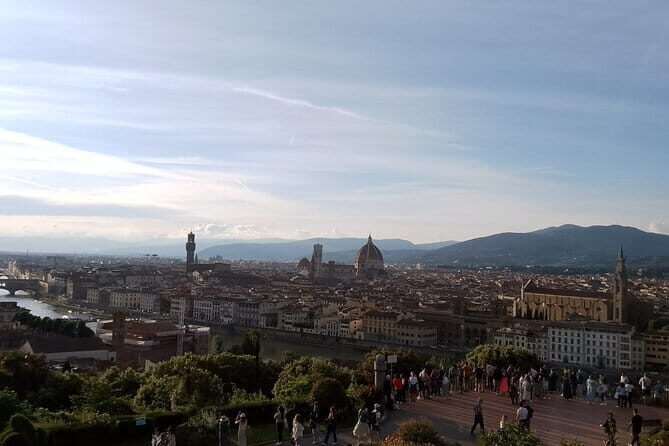
- Piazza Santa Trinita and Ponte Vecchio: the easy-to-miss artistic corridor
- Santo Spirito and Il Crocifisso Ligneo: the young Michelangelo moment
- What the 3 hours feels like on your feet (and how to plan for it)
- Price and value: is $31.35 actually a bargain?
- Who this tour suits best
- Should you book this Renaissance rivalry tour?
- FAQ
- How long is the Renaissance Florence tour?
- Where does the tour start and end?
- What time does the tour begin?
- Is it a walking tour, and how many people are in the group?
- What’s included in the price?
- What admission tickets are not included?
- Which Michelangelo artwork do you see?
- Do I need good weather for the tour?
- Are service animals allowed?
Key moments worth circling first
- Il Crocifisso Ligneo at Santo Spirito: a young Michelangelo work with a ticket included
- Piazza della Signoria as an outdoor sculpture lesson with Cellini and Giambologna
- Duomo-area exteriors: Brunelleschi’s dome facts plus Giotto’s bell tower history from the street
- San Lorenzo + Medici power: New Sacristy and the Laurentian Library linked to Michelangelo
- Small-group pacing: about 3 hours, manageable, capped at 16 people
Michelangelo vs Leonardo: how the rivalry changes what you notice
If you’ve only seen Renaissance Florence through famous paintings, this tour gives your eyes a new job. The whole idea is simple: Michelangelo and Leonardo weren’t just producing art; they were also responding to rules, patronage, politics, and each other. When you get that framework, even stone and street-level details start to feel like part of the story.
You’ll hear about their different temperaments and methods, and how that competition shows up in the way figures move, how anatomy becomes believable, and why certain commissions mattered. That matters because Florence wasn’t a “museum city” back then—it was a workshop city. Your guide’s goal is to make the Renaissance feel like something you can still read in public spaces.
The other advantage is pacing. This isn’t a marathon of churches; it’s a focused loop that keeps returning to the same theme: artistic ambition meeting Florentine power.
You can also read our reviews of more tours and experiences in Florence.
- Tuscany Day Trip from Florence: Siena, San Gimignano, Pisa and Lunch at a Winery
★ 5.0 · 21,634 reviews
Piazza della Signoria and Palazzo Vecchio: politics as the first art lesson
You start at Piazza della Signoria, the nerve center of Florentine civic life for centuries. This is where power lived in daylight: government, public ceremony, and art were all mixed together in one place. In practice, it’s an easy way to get your bearings fast without needing a ticket for the first step.
From there, you’ll connect Palazzo Vecchio to the square. The tour emphasizes the monumental presence of Palazzo Vecchio from the outside, which is useful if you don’t want to spend your limited time wrestling with lines or extra admissions. It also frames the rest of the walk: you’re learning what Florence wanted to project about itself.
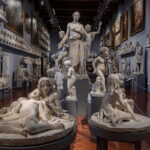
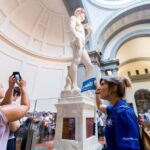
Then you move into the open-air museum feeling of the piazza. The Loggia dei Lanzi sits right nearby, and you’ll see major sculpture names like Benvenuto Cellini’s Perseus with the Head of Medusa and Giambologna’s The Rape of the Sabine Women. There’s also a replica of Michelangelo’s David, which works as a great “visual anchor” as the tour keeps circling back to how sculptors shaped human form.
One practical tip: this area can get crowded depending on the hour. The value here is that you’re learning what you’re looking at, not just watching a statue from 10 feet away and hoping it clicks.
Duomo complex exteriors: Brunelleschi and Giotto without ticket stress
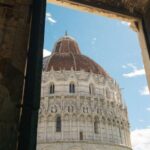
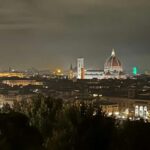
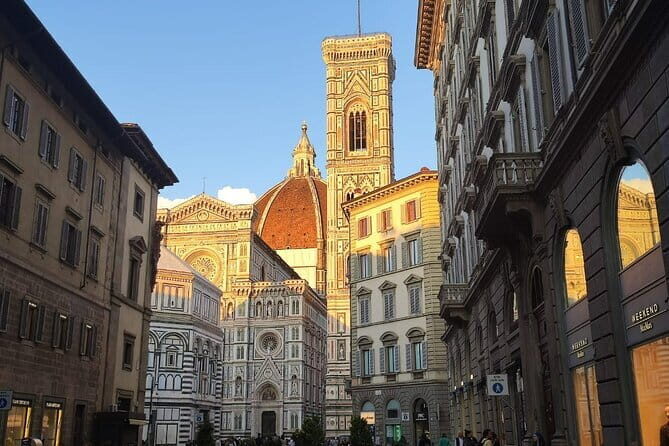
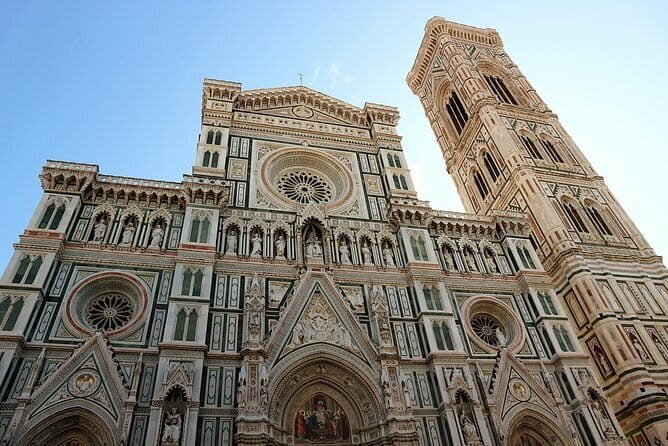
Stop three is the Duomo area—Santa Maria del Fiore, Giotto’s Bell Tower, and the Baptistery of St. John—seen from outside. Tickets for the Duomo complex aren’t included, so plan on this being an architecture-and-story stop rather than an interior visit. If that fits your style, you’ll love it, because the guide points out features you might otherwise miss from the street.
You’ll hear the mechanics behind Brunelleschi’s dome. The dome is described as the largest brick dome ever constructed, using a double shell and a herringbone brick pattern for stability. That kind of detail turns the dome from a pretty shape into a technical achievement—and that’s exactly the Renaissance mindset your guide wants you to absorb.
For Giotto’s bell tower, you get the key timeline: Giotto designed it and lived just long enough to see the lower levels completed, with Andrea Pisano and Francesco Talenti finishing the work afterward. It’s a good reminder that Renaissance projects were team efforts, even when we remember one name most loudly.
San Lorenzo: Medici family muscle and Michelangelo’s fingerprints
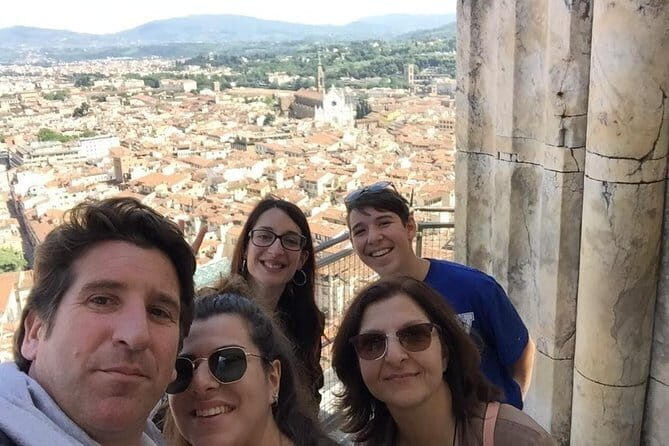
San Lorenzo is where Florence’s religious center and its political center shake hands. You’ll visit the Basilica di San Lorenzo area and see how deeply the Medici family shaped the city’s spiritual and artistic landscape. The chapels here act as the family mausoleum, so the art is tied to status, memory, and power.
The tour highlights the New Sacristy, designed by Michelangelo. Even from a walking pace outside the main complex, knowing that detail changes how you think about what you’re seeing. It’s not just church decoration; it’s a stage for Renaissance sculpture and architecture aimed at lasting fame.
You’ll also connect Michelangelo to the Laurentian Library, including its distinctive staircase design. That’s a helpful link because it shows how his interest in human form and dramatic movement doesn’t stop at sculpture—it carries into built space too.
There’s also time around San Lorenzo Market (Mercato di San Lorenzo), and since it’s free to enter the area, it can be a nice reset. Just keep in mind this part can feel busier than the earlier stops, because it’s an active shopping zone.
Piazza Santa Trinita and Ponte Vecchio: the easy-to-miss artistic corridor
After the heavier history stops, you get a calmer segment along Via de’ Tornabuoni and into Piazza Santa Trinita. This is a small square, but it’s positioned in a part of town that feels more residential and elegant than the main “big sights” lanes. The tour’s value here is the shift in mood.
Then comes Ponte Vecchio, the famous bridge over the Arno. This is a quick stop, but it gives you something useful: a sense of how Florence “connects” its landmarks. Architecture isn’t isolated here; streets and crossings shape daily movement, which is exactly why Renaissance art ended up everywhere—from civic squares to church interiors and public bridges.
If you’re the type who likes photos, this is where the city makes it easy. If you’re the type who prefers learning, it helps to remember that bridges like this were part of the city’s everyday display.
- Tuscany Day Trip from Florence: Siena, San Gimignano, Pisa and Lunch at a Winery
★ 5.0 · 21,634 reviews

Santo Spirito and Il Crocifisso Ligneo: the young Michelangelo moment

The final highlight is Basilica di Santo Spirito in the Oltrarno district. This is where the tour earns its reputation for going off the standard circuit. The guide includes admission here, and you’ll have the chance to see Michelangelo’s wooden crucifix, Il Crocifisso Ligneo.
This work matters because it’s early. The tour explains it as an early masterpiece sculpted by Michelangelo at just 17 years old. Even if you already know Michelangelo as a legend, this detail gives you a different perspective: you get to consider how early ambition, study, and opportunity can turn into skill before fame.
The tour also ties the crucifix to a very specific reason he was allowed to study anatomy. The crucifix was created to thank the Prior for granting that permission, and the tour frames that as a stepping stone to Michelangelo’s later understanding of the human form. That’s one of those stories that changes how you look at later Renaissance figures—because you start thinking about access and education, not just genius.
Santo Spirito itself is designed by Brunelleschi, so the stop works on two levels: architecture plus sculpture. And because it’s in Oltrarno, it tends to feel calmer than the loudest central corridors. Plan to slow down here. This is your pay-off stop.
What the 3 hours feels like on your feet (and how to plan for it)
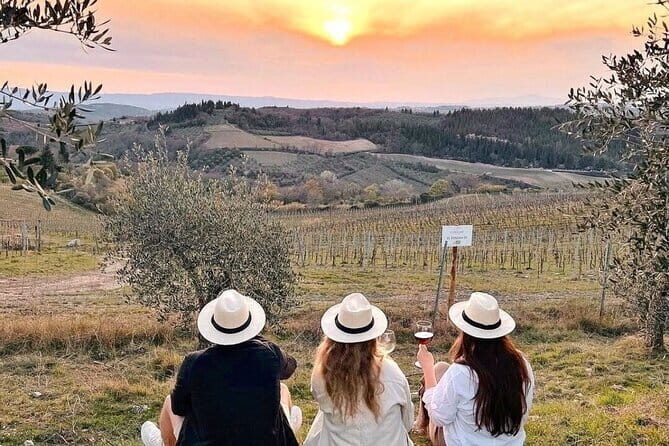
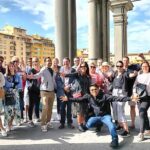
This tour runs about 3 hours and is capped at a maximum of 16 people. That’s a sweet spot for Florence: big enough for energy, small enough that your guide can keep an eye on the group and answer questions.
You’re walking between key areas, mostly outdoors, so comfortable shoes matter more than heavy layers. The tour also says it requires good weather, so if rain is in the forecast, expect the provider to offer a different date or a refund. In plain terms: check the sky the day before, and don’t wear your newest blister-producing shoes unless you enjoy suffering.
Most travelers can participate, and service animals are allowed. That’s a good sign if you’re traveling with mobility needs and want a straightforward route without complex transfers.
Price and value: is $31.35 actually a bargain?
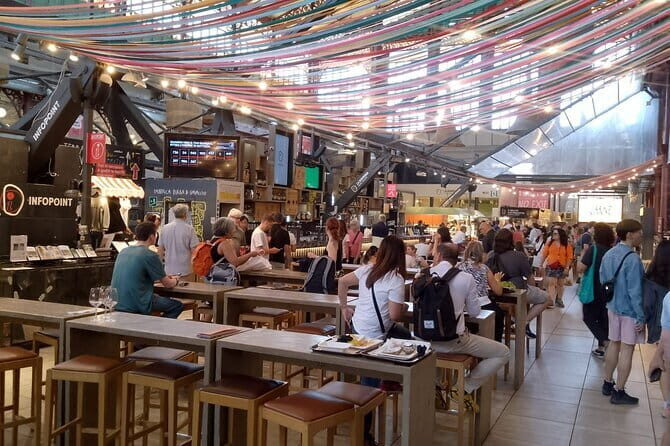
$31.35 per person for a 3-hour Florence tour is not just “a low price.” It’s value because the tour includes two things that often cost extra on their own: a professional local guide and the ticket for the Michelangelo wooden cross at Santo Spirito.
Then there’s the other included item people tend to remember: Antonio’s code, described as the most important books of Florence with the best venues for food, music, drinks, and museums. That’s not just sightseeing; it’s a way to keep learning after the walk ends. If you like to plan your next meals and your next rainy-day museum visit, it’s a practical perk.
Admission tickets are not included for Palazzo Vecchio and the Duomo complex. But since those stops are exterior visits, you avoid the most common “I paid but didn’t see inside” disappointment. If you want interiors, you’ll need to budget separately—or pick another tour that matches that goal.
Who this tour suits best
This is a great match if you:
- love Renaissance art but want it explained through rivalry, not just famous names
- enjoy sculpture and architecture as stories you can read in public spaces
- want a quieter ending with Santo Spirito and Il Crocifisso Ligneo
It might not be ideal if your top priority is “inside-the-building tickets” at every stop. Here, you’ll mostly experience exteriors—useful, but not the same as a gallery deep dive.
Also, because the story centers on Michelangelo and Leonardo, this is a particularly good pick for first-time Florence visitors who already know the basics and want the next layer.
Should you book this Renaissance rivalry tour?
Yes—if you want Florence to feel like a living argument between artists, not a checklist of crowds. The strongest reason to book is the ending: Il Crocifisso Ligneo at Santo Spirito, where the tour connects a young Michelangelo work to anatomy study and patron approval. That kind of cause-and-effect story is hard to get on a generic “Renaissance hits” walk.
If you’re okay with exterior views at Palazzo Vecchio and the Duomo complex, the rest of the itinerary makes a lot of sense. You’ll get sculpture, major architectural context, and a guide who can turn famous names into something you can actually picture on the street.
FAQ
How long is the Renaissance Florence tour?
The tour is approximately 3 hours.
Where does the tour start and end?
It starts at Piazza della Signoria (P.za della Signoria, 50122 Firenze FI, Italy) and ends in front of Santa Croce church in Florence.
What time does the tour begin?
The start time listed is 10:00 am.
Is it a walking tour, and how many people are in the group?
It’s a walking tour. The group is capped at a maximum of 16 travelers.
What’s included in the price?
Included are a professional enthusiastic local tour guide, an Antonio’s code resource, a professional English tour guide, and the ticket for Michelangelo’s wooden cross.
What admission tickets are not included?
Admission tickets are not included for Palazzo Vecchio and Duomo – Cattedrale di Santa Maria del Fiore.
Which Michelangelo artwork do you see?
You visit Basilica di Santo Spirito to see the Michelangelo wooden crucifix, Il Crocifisso Ligneo.
Do I need good weather for the tour?
Yes. The experience requires good weather, and if it’s canceled due to poor weather, you’ll be offered a different date or a full refund.
Are service animals allowed?
Yes, service animals are allowed.
You Might Also Enjoy


More Tour Reviews in Florence
- Tuscany Day Trip from Florence: Siena, San Gimignano, Pisa and Lunch at a Winery
★ 5.0 · 21,634 reviews - The Best tour in Florence: Renaissance & Medici Tales – guided by a STORYTELLER
★ 5.0 · 12,316 reviews