REVIEW · FLORENCE
Journey Through Time in Volterra – Exclusive Private Tour
Book on Viator →Operated by Luisa Quaglia · Bookable on Viator
Volterra is small, but it packs a punch. This exclusive private tour turns a quick stroll through a walled mountaintop town into a clear story of Etruscans, Romans, and medieval life. Two things I really enjoy here are the tight, end-to-end sightline route (no aimless wandering) and the way your licensed guide, Luisa Quaglia, keeps the whole walk easy to follow while still full of detail.
You’ll also like how the tour stays focused on what you can actually see in Volterra’s streets and squares. You hit Piazza dei Priori, the rare Etruscan Porta all’Arco, the Duomo square (from the outside), and a Roman theater viewpoint that helps you understand what you’re looking at without needing to go inside.
One possible drawback to consider: this is a mostly “look-and-learn from vantage points” style tour. If you’re hoping for lots of interior visits, you’ll want to know that the plan centers on squares and viewpoints rather than tours inside the buildings.
In This Review
- Key Points to Know Before You Go
- Why Volterra’s Walls Make This 2-Hour Walk Feel Like a Time Machine
- Meeting at Piazza Martiri della Libertà and Finding the Route Rhythm
- Piazza dei Priori: Volterra’s Civic Heart in One Square
- Porta all’Arco: The Rare Etruscan City Gate You Can Stand Near
- Cattedrale Santa Maria Assunta: What You Learn From the Duomo Square
- Teatro Romano: Understanding Rome From a Viewpoint, Not a Ticket Line
- The Luisa Quaglia Factor: Clear Explanations and Real Q&A
- What You’ll See Beyond the Big Names: Streets, Squares, and Alabaster Craft
- Price and Value: $248.05 Per Group for Up to 10
- Practical Notes That Actually Matter (Weather, Walking, and What’s Included)
- Who This Volterra Private Tour Is Best For
- Should You Book This Volterra Private Tour?
- FAQ
- How long is the Volterra private tour?
- Where does the tour start and end?
- What language is the tour offered in?
- Is this a private tour?
- What’s the group size?
- Does the tour include visits inside the Duomo or other buildings?
- Is transportation included in the price?
- What happens if the weather is bad?
Key Points to Know Before You Go
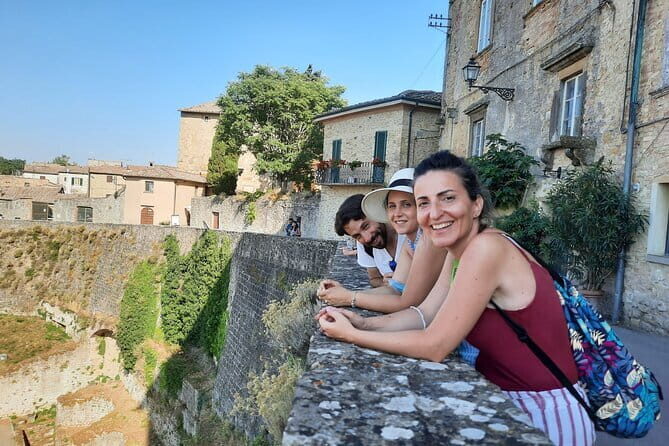
- Private guide, up to 10 people: you get a real Q&A flow and a pace that fits your group.
- Etruscan to Roman in one circuit: Porta all’Arco and the Teatro Romano are linked with clear explanations.
- Outside-only at the Duomo area: you visit the cathedral square without entering.
- Panoramas built into the route: Volterra’s elevated position is part of the experience, not an afterthought.
- Alabaster craft shows up on the walk: you get context for how Volterra’s stone becomes statues.
- English language tour with a mobile ticket for an easier start.
Why Volterra’s Walls Make This 2-Hour Walk Feel Like a Time Machine
Volterra works because it’s perched above the landscape. The town walls and the compact street grid naturally “stage” the past where you can see it. In about two hours, you can watch the character of the place shift—from Etruscan fortifications to Roman civic life to medieval power—without changing hotels, buses, or plans.
I love that the tour is built around big visual anchors. You don’t just get names of monuments; you get help turning what you see into a mental map. Then the guide adds context so those anchors start telling a story: who controlled the city, how it defended itself, and why the Romans kept it important after conquest.
The private format matters too. With only your group, it’s easier to ask the odd question that usually gets lost in larger tours. And with Luisa Quaglia, the explanations feel structured, with room for curiosity.
You can also read our reviews of more private tours in Florence

Meeting at Piazza Martiri della Libertà and Finding the Route Rhythm
The tour starts in Piazza Martiri della Libertà in Volterra (56048), and it ends at Teatro Romano. That end point is a clue: the route is designed to carry you through the main storytelling stops, finishing with the Roman theater viewpoint and the dramatic sense of place that comes with it.
Time-wise, plan on about two hours. This is enough to cover the key landmarks without turning into a “marathon of monuments.” It also means you’ll want to arrive ready to walk and look closely. Volterra is a hillside town, so even if the pace is comfortable, you’ll still feel elevation in your legs.
You’ll also get a mobile ticket, which makes day-of life easier. And since this is an exclusive private tour, it stays limited to your group rather than mixing in strangers mid-walk.
Piazza dei Priori: Volterra’s Civic Heart in One Square
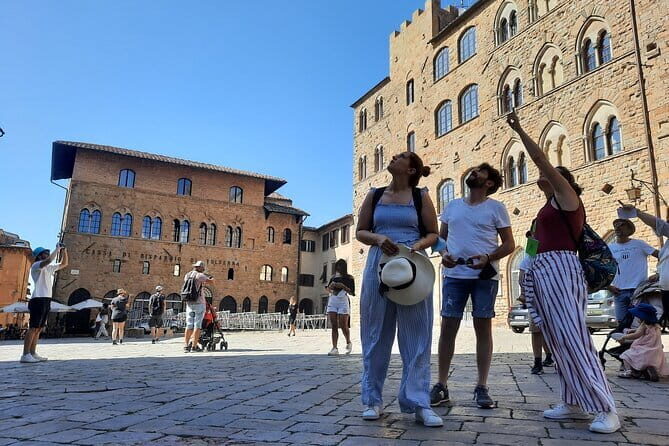
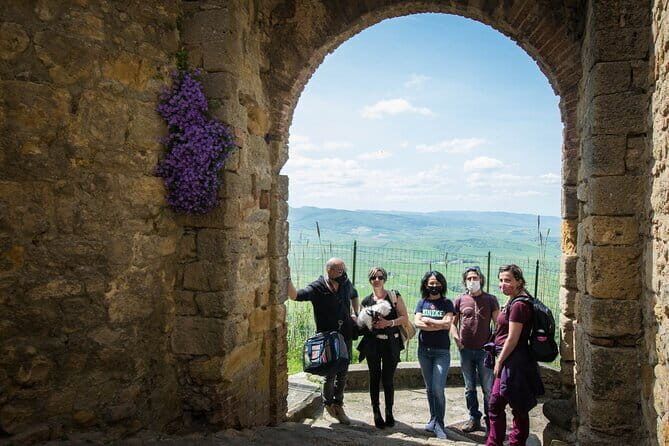
Your first major stop is Piazza dei Priori, the core of the city. This is where Volterra shows its “Communal Age” identity—think civic pride, government power, and the architecture that announced who mattered.
The square is overlooked by important buildings of that era, including Palazzo dei Priori and Palazzo Pretorio. Even from the outside, you can read the square like a stage: the way the buildings frame the space helps you understand how public life would have centered here.
The value of starting here is pacing. You begin with the civic world before the tour shifts toward Etruscan defenses and religious landmarks. It gives you a foundation: Volterra wasn’t only stone and ruins—it was organized, governed, and proud.
If you’re a person who likes context before images, this stop will feel satisfying right away. If you prefer deeper museum-style details, you’ll still get enough explanation to make the square feel connected to the rest of the route.
Porta all’Arco: The Rare Etruscan City Gate You Can Stand Near
Next comes Porta all’Arco, one of the reasons Volterra is such a special archaeological place. The Etruscans built this city as a rich, powerful center, and the gate is a rare survival—an Etruscan city gate that you can actually see as part of the modern town fabric.
What I like about this stop is that it’s not just a “spot photo here” moment. The guide’s job is to help you understand what a gate meant beyond its doorway shape. It was defense, control, and a visible statement of authority. When you stand near it, you’re also standing in the middle of the city’s long memory.
This stop also works well for first-timers because it’s concrete. You don’t need prior knowledge to grasp it. Your guide can connect the gate to the idea of Volterra as a long-used strategic location—not a place that suddenly became important once the Romans showed up.
Cattedrale Santa Maria Assunta: What You Learn From the Duomo Square
From there, the route moves to the Duomo area—specifically the square overlooking Cattedrale di Santa Maria Assunta, the baptistery, and the former hospital. The plan here is simple and smart: you visit the square, not the interiors.
That matters. Interior visits can be great, but they also eat time and often involve waiting or ticketing. By focusing on the square, the guide can point out the relationships between the religious buildings and how they shaped the public life of Volterra.
Here’s one detail that makes the place more than pretty stone: Volterra is connected to the birth of St. Linus, described as the second pope after St. Peter. His early evangelization helped spur an early diocese that became influential and wealthy through the Middle Ages and beyond. Standing in the square helps you understand why this kind of institution mattered in a town built on elevation and endurance.
If you’re the type who hates rushing through sites, you’ll probably appreciate this “outside first” approach. You still leave with context; you just don’t spend your limited time inside rooms you may not even be able to fully absorb.
- Tuscany Day Trip from Florence: Siena, San Gimignano, Pisa and Lunch at a Winery
★ 5.0 · 21,634 reviews


Teatro Romano: Understanding Rome From a Viewpoint, Not a Ticket Line
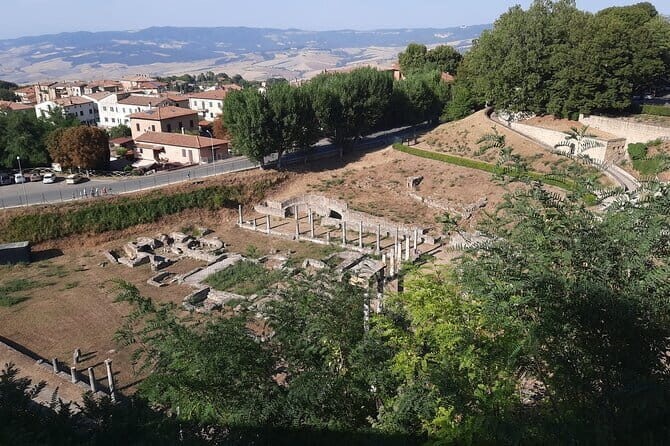
Volterra remained important under Roman rule, and the Teatro Romano is your payoff. The plan focuses on explaining the theater from a vantage point that helps you interpret it without going inside.
This is a useful approach. Roman theaters can feel confusing if you only look at ruins. From the right viewpoint, you can understand the structure’s purpose, how people would have gathered, and how Roman urban life continued in Volterra long after Etruscan influence. You also get clues that other Roman buildings existed here too, including baths, even if those aren’t the main focus of the walk.
Another part of this stop is the feeling of place. Because Volterra sits high, the views from the Roman area don’t just add scenery—they connect the monuments to the geography. You start to see why this city mattered: visibility, defense, and control over the surrounding region.
By the time you reach the theater viewpoint at the end of the tour, you’ve basically traveled through time using sightlines as your guide. That’s the genius of the route: the last stop makes the earlier ones easier to understand.
The Luisa Quaglia Factor: Clear Explanations and Real Q&A

The experience is led by Luisa Quaglia, and the feedback points to why this tour works. You’ll get a guide who keeps things organized, answers questions directly, and explains in a way that makes complex history feel usable.
One theme that really shows up in the way Luisa teaches: she’s good at taking your curiosity seriously. If you ask why something was built, what it replaced, or how it fits into the bigger timeline, you’re not treated like an interruption. The walk stays interactive rather than lecture-only.
There’s also a teaching style that makes information easier to hold in your head. It’s the kind of approach that feels built for different attention spans—short explanations when you want them, more detail when you ask for it. That balance is a huge part of the value of a private tour.
Also, this is English-language. If you’ve ever tried to follow a site solo and found yourself lost, you’ll probably appreciate that you can keep moving while still feeling oriented.
What You’ll See Beyond the Big Names: Streets, Squares, and Alabaster Craft
This is not only about official monuments. The walk also brings in Volterra’s craft identity—especially the local alabaster tradition. In the way the tour is described, you’ll get to understand how alabaster stones are converted into statues.
That kind of context changes how you look at the town. Volterra isn’t just a place where the past is preserved—it’s a place where material culture mattered. Even if you’re mainly here for ruins and architecture, learning what locals historically made with what they had helps connect “history” to actual daily life.
You’ll still get the anchor stops, but don’t ignore the in-between moments. The streets and small transitions are where your guide’s story stitching really lands—how Etruscan gate logic relates to Roman civic spaces, and how medieval power reshaped religious and public landmarks.
If you enjoy turning a walk into a narrative, this tour’s structure will suit you.
Price and Value: $248.05 Per Group for Up to 10
The price is $248.05 per group for up to 10 people, and it runs about two hours. On paper, that sounds like “for groups,” but it can still be good value if you’re the kind of duo or family that wants control over the day.
Here’s how I’d think about value. A two-hour guided walk in a town like Volterra gives you three things you might not get on your own:
1) You don’t have to decode the timeline alone.
2) You get help seeing why one stop leads to the next.
3) Your guide can tailor the pace and answer your questions.
If you’re traveling with a few people, splitting the group cost can make this feel very reasonable compared to paying for separate guided segments. Also, the private format keeps you from wasting time waiting around for everyone to catch up.
The tour being in English helps too—especially if your group doesn’t read Italian fluently. And since the route is compact, you won’t need extra planning for transportation as part of the experience.
Practical Notes That Actually Matter (Weather, Walking, and What’s Included)
A couple practical points will help you enjoy this more.
First: good weather matters. The experience notes that it requires weather, and if conditions are poor, you’ll be offered another date or a full refund. Volterra is best when you can see the panoramas clearly and when you’re not rushing between shaded corners.
Second: the tour is mainly outside and viewpoint-based, with short stops at each location. That’s generally easy to manage, but still plan for walking and hillside terrain. Comfortable shoes help more than you’d expect.
Third: private transportation isn’t included. If you’re already in Volterra, that’s fine. If you’re coming from Florence, you’ll need your own plan to get to the start point and then back after the tour ends at Teatro Romano.
Lastly, the tour includes a licensed professional guide and a mobile ticket. Service animals are allowed, and the experience says most people can participate, which makes it a safer bet for mixed groups than tours that require lots of stairs or museum stamina.
Who This Volterra Private Tour Is Best For
This tour is a strong fit if you want a history-focused walk without turning it into a full day of ticket lines and indoor rooms. You’ll probably enjoy it if you:
- like seeing how different eras overlap in one town
- want clear explanations while walking, not after you get back to your hotel
- travel with family or friends who would benefit from a private pace
- prefer a route built around the most meaningful places, not a random list
It’s especially good for people who ask questions. The guide’s strength is answering and connecting topics—so the tour feels like a conversation with the city, not a one-way lecture.
If you’re planning a short Volterra stop from Florence, this two-hour circuit gives you structure quickly.
Should You Book This Volterra Private Tour?
I’d book it if you want a fast, high-signal introduction to Volterra that you can understand as you go. The lineup—Piazza dei Priori, Porta all’Arco, the Duomo square viewpoint, and the Teatro Romano explanation—creates a clean timeline you can actually hold onto. Add in Luisa Quaglia’s Q&A-friendly teaching style, and you get both meaning and momentum.
Skip it only if your dream Volterra day is mostly interior visits and long museum-style time. This walk is built for looking, learning, and moving through a walled town with pan views as part of the story.
FAQ
How long is the Volterra private tour?
It’s about 2 hours.
Where does the tour start and end?
It starts at Piazza Martiri della Libertà, Volterra (56048) and ends at Teatro Romano in Volterra.
What language is the tour offered in?
The tour is offered in English.
Is this a private tour?
Yes. It’s private, and only your group participates.
What’s the group size?
The tour is priced per group for up to 10 people.
Does the tour include visits inside the Duomo or other buildings?
No. The plan includes visiting the Duomo square, but it does not include a tour inside the buildings. The theater is explained from a vantage point without going inside.
Is transportation included in the price?
No. Private transportation is not included.
What happens if the weather is bad?
The experience requires good weather. If it’s canceled due to poor weather, you’ll be offered a different date or a full refund.
You Might Also Enjoy
More Private Tours in Florence


More Tours in Florence
- The Best tour in Florence: Renaissance & Medici Tales – guided by a STORYTELLER
★ 5.0 · 12,316 reviews


More Tour Reviews in Florence
- Tuscany Day Trip from Florence: Siena, San Gimignano, Pisa and Lunch at a Winery
★ 5.0 · 21,634 reviews - The Best tour in Florence: Renaissance & Medici Tales – guided by a STORYTELLER
★ 5.0 · 12,316 reviews