REVIEW · FLORENCE
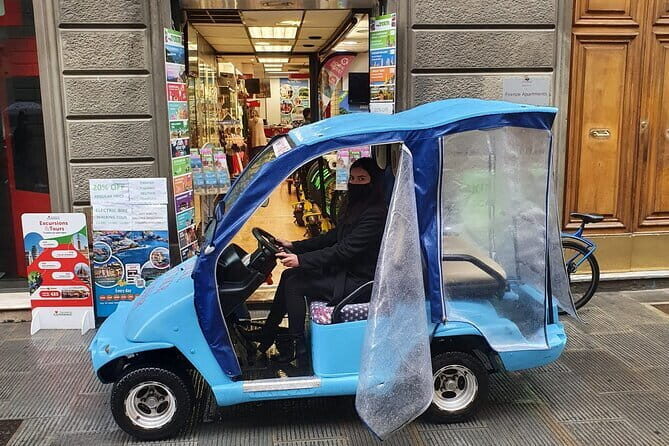
Private Florence Highlights Electric Tour
Book on Viator →Operated by Eco Florence Tour · Bookable on Viator
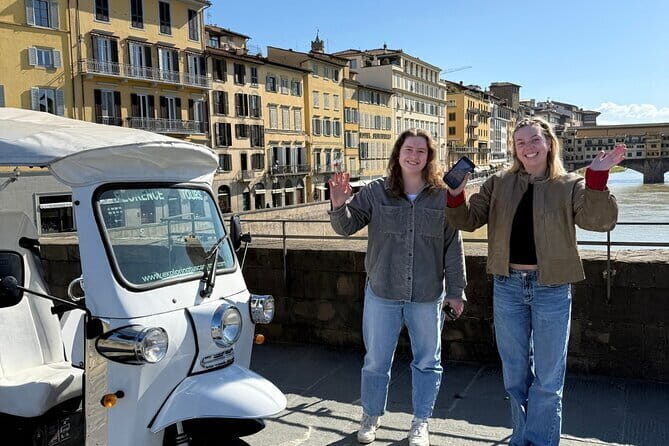
Florence can feel like a lot at once, but this quick electric loop helps you see the big moves fast. You start near San Lorenzo and ride to classic landmarks like Santa Croce, Ponte Vecchio, and Piazzale Michelangelo, with WiFi on board for easy map-checking. I love the way you get major sights without long walking, and I especially like the mix of squares, churches, Medici palaces, and river bridges—stuff you can keep picturing later. One thing to consider: this is often set up as an audio guide experience, so if you want nonstop live commentary, confirm what’s delivered and whether it can be turned off.
In This Review
- Key moments you’ll feel right away
- Why a private electric cart tour makes sense for Florence highlights
- Where you start at Piazza di San Lorenzo (and how the route flows)
- Piazza Santa Croce: the Franciscan heart you’ll recognize instantly
- Biblioteca Nazionale Centrale: a 1930s building with a medieval wink
- San Miniato al Monte: the Romanesque church built for views
- Piazzale Michelangelo: the “first panoramic viewpoint” idea
- Oltrarno: “beyond the Arno” and the Medici shift in the 1500s
- Ponte alla Carraia and the working-city Florence angle
- Back to Santa Croce (and why the timing is smart)
- Palazzo Medici Riccardi: one building, one family, a clear message
- Basilica di San Lorenzo and the Brunelleschi rebuild
- Cappelle Medicee: a mausoleum you’ll understand faster with context
- Santa Maria Novella: Dominican sermons turned into a landmark square
- Ognissanti Church and the Umiliati wool connection
- Ponte Santa Trinita: the beloved bridge rebuilt after a flood
- Ponte Vecchio and the Vasari Corridor: the stars of the river
- Palazzo Pitti and the finish at Piazza Pitti
- What $83.45 gives you in real terms (and what it doesn’t)
- Getting the most out of the English audio (and how to avoid disappointment)
- Who should book this electric Florence highlights tour
- Should you book? My practical take
- FAQ
- How long is the Private Florence Highlights Electric Tour?
- What does the tour cost?
- Where do we meet for the tour?
- Is the tour offered in English?
- Is admission to attractions included?
- What’s included in the tour price?
- Is this a private tour?
- Can the tour end somewhere other than the starting point?
- Are service animals allowed?
- What if weather is bad or I need to cancel?
Key moments you’ll feel right away
Short stops, big payoff: You get photo time and orientation, not museum-style wandering.
High-contrast Florence: Romanesque views at San Miniato, then Renaissance-and-Medici power stops.
River bridges on a tight schedule: Ponte alla Carraia, Santa Trinita, and Ponte Vecchio all get their moment.
Viewpoint included: Piazzale Michelangelo is timed in, so you’re not guessing when to go.
Medici storytelling stops: Palazzo Medici Riccardi and the Medici Chapels anchor the political art angle.
Why a private electric cart tour makes sense for Florence highlights
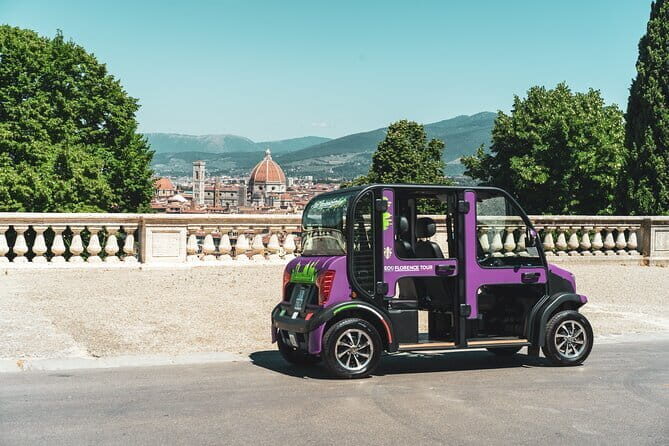
Florence rewards curiosity, but it punishes bad planning. This 1 hour 30 minute private electric tour is built for people who want to get their bearings fast and still cover the places that show up in almost every great Florence photo.
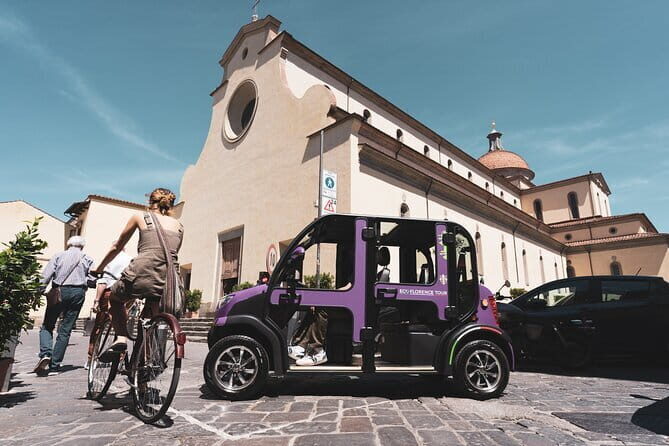
You ride in an open-air style vehicle through narrow streets and close-in areas where walking can eat your time. The stops are deliberately short—usually a few minutes—so the goal is clear: you see, you photograph, you get context, and then you decide what’s worth your effort later (maybe a longer church visit, maybe a proper lunch near a square).
I also like that it’s private. Even if your group splits into separate vehicles for size, you’re still in your own bubble and can move at the pace that works for you. The tour is offered in English, and you’ll have WiFi on board, handy for checking hours, ticket lines, or simply confirming where the next stop is on your phone.
You can also read our reviews of more private tours in Florence

Where you start at Piazza di San Lorenzo (and how the route flows)
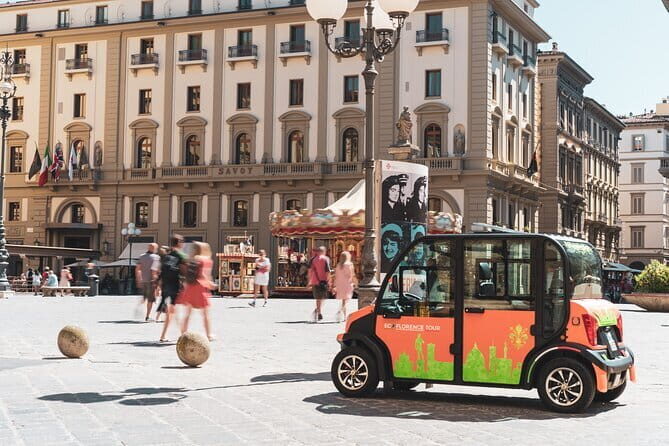
Your meeting point is Trattoria Sergio Gozzi at Piazza di San Lorenzo, 8R. That matters more than it sounds. From here, you’re positioned to reach both sides of the historic center quickly, without starting at the far edges of Florence.
You end back at the same address by default, but the tour can end at any point within the route upon request. That small flexibility is useful if you’re planning dinner nearby or want to connect straight to another activity after the cart ride.
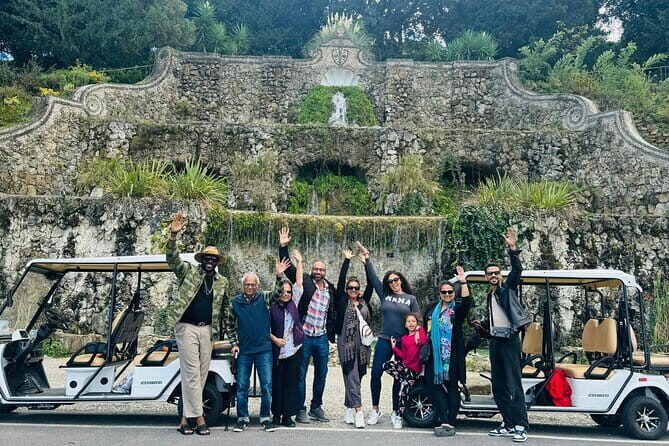
As for comfort and group size: one review response notes that the authorized vehicle maximum is 5 passengers. If you book with a larger group, you may be split into multiple electric vehicles. In practice, that can still work well—just plan that you might not be physically side-by-side the whole time.
Piazza Santa Croce: the Franciscan heart you’ll recognize instantly
You’ll make a first stop at Piazza Santa Croce and the basilica area. Santa Croce is one of Florence’s most instantly recognizable squares: open space, historic buildings, and that strong “Florence on a postcard” feeling—without needing to line up for anything.
This stop is also smart because it sets a theme early: the Franciscan influence is built into the basilica story. The tour route points out the long-running Franciscan presence (since 1226), and once you know that, you’ll spot how the site feels less like a single monument and more like a living center of community.
A practical note: admission is not included for attractions, so if you want to go inside, plan for tickets and a bit of extra time. With a 90-minute schedule, you might only be able to enter one church if you choose to.
Biblioteca Nazionale Centrale: a 1930s building with a medieval wink
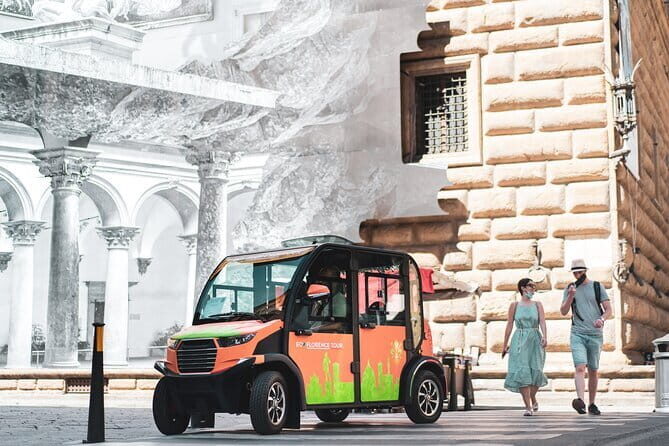
Next you’re at Biblioteca Nazionale Centrale, a National Library built in the 1930s using Pietraforte stone. What I like about this stop is that it’s not just another “look at a famous facade.” It shows how Florence mixes eras—an eclectic style that blends medieval and Renaissance elements.
Even if you don’t go in, the exterior gives you something useful: it’s a reminder that Florence isn’t frozen. It kept building, adapting, and redefining what the city looks like.
San Miniato al Monte: the Romanesque church built for views
Then comes Basilica di San Miniato al Monte. This stop is timed for two reasons: the church itself (a fine example of Florentine Romanesque architecture) and the panoramic view over Florence.
I like this spot because it changes your perspective. Florence is famous for its rooftops and domes, but from street level you don’t always see the whole pattern. From San Miniato, the city reads like a layout, not just a series of landmarks.
You also learn a neat detail that sticks: the basilica sits on Mons Florentinus, tied to early Christian communities and catacombs. It’s the kind of fact that turns a quick photo moment into something you remember.
- Tuscany Day Trip from Florence: Siena, San Gimignano, Pisa and Lunch at a Winery
★ 5.0 · 21,634 reviews

Piazzale Michelangelo: the “first panoramic viewpoint” idea
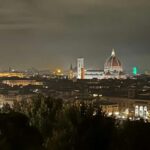
After the hilltop church, the route takes you to Piazzale Michelangelo—Florence’s famous balcony. This square was created between 1865 and 1875, designed by Giuseppe Poggi, during the city’s time as capital of the newly unified Kingdom of Italy.
If you’re wondering why this square feels so designed, that’s the answer. It wasn’t just about a view—it was about turning that view into a public experience. For first-timers, it’s one of the easiest places to understand why artists and dreamers kept flocking to Florence.
Timing tip: this stop is short, but you can still do something useful. Take your wide shot, then turn for a second angle of the city. You’ll notice how different the Duomo area looks from one direction to the other.
Oltrarno: “beyond the Arno” and the Medici shift in the 1500s
You then roll into Oltrarno, the district “beyond the Arno.” The tour frames it in two layers: it began developing in the 1200s as people moved from the countryside toward the city, and later expanded in the 16th century when the Medici court arrived at Palazzo Pitti.
Oltrarno is where Florence feels more local and less postcard-only. On this route, you’re not spending all day there—you’re just sampling the feel. It’s a great stop to help you decide where you might want to wander on foot later.
Ponte alla Carraia and the working-city Florence angle
Your next river stop is Ponte alla Carraia, built in 1218. The naming story is the kind of detail that makes a bridge feel human: it was used for transporting goods on carts.
That’s a nice shift from the more ceremonial sites. Florence had commerce, daily needs, and logistics—and the bridges were part of that reality. Even with a brief stop, it gives you a better mental map of what the Arno meant beyond scenery.
Back to Santa Croce (and why the timing is smart)
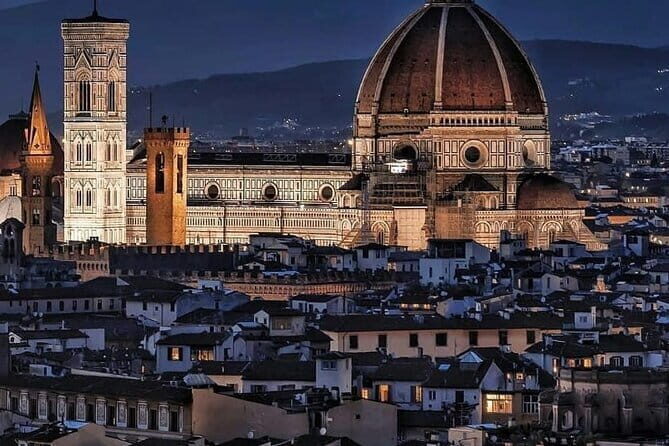
The tour returns to Basilica di Santa Croce again. Yes, it’s a repeat area—but it’s useful. The first time you’re oriented in the square; the second time, you get another chance to look closely and compare details.
You also get the basilica timeline: construction began in 1294 under Arnolfo di Cambio and was completed in 1444. The route emphasizes that neighborhood funding helped shape the size and beauty of the church, which makes sense when you think about Santa Croce as a district anchor.
If you’re the type who likes to pick one interior visit, this is a strong candidate. But keep tickets in mind: entry isn’t included.
Palazzo Medici Riccardi: one building, one family, a clear message
You then reach Palazzo Medici Riccardi, commissioned around 1445 by Cosimo the Elder and designed by Michelozzo. The Medici power story is made concrete here: the palace exists to show wealth and influence in stone.
I like this stop because it turns the abstract name Medici into something you can point to. You’ll see why Florence’s art and politics weren’t separate worlds.
Again, no admission is included, so treat it as an exterior “read the architecture” moment unless you’ve planned tickets elsewhere.
Basilica di San Lorenzo and the Brunelleschi rebuild
Next is Basilica di San Lorenzo, tied to older worship sites outside the Roman walls. What you’ll hear in the tour messaging is that this basilica was rebuilt starting in 1419, with Filippo Brunelleschi as the young architect chosen under the will of Giovanni di Bicci, father of Cosimo the Elder.
This is a great example of how Florence layers time. Even if you don’t go inside, the story explains why the basilica feels like a crossroads of older foundations and newer ambition.
Cappelle Medicee: a mausoleum you’ll understand faster with context
Then comes Cappelle Medicee—the Medici Chapels, described as a kind of mausoleum for the ruling family. The tour calls out the New Sacristy in the left transept and the Chapel of the Princes behind it.
Even a short stop helps if you’re the kind of person who likes meaning, not just marble. The Medici weren’t only patrons; they were also staking claims about legacy. That’s exactly what chapels like these were built to do.
If you want to enter, you’ll need tickets since admission isn’t included.
Santa Maria Novella: Dominican sermons turned into a landmark square
The route includes Basilica and Piazza of Santa Maria Novella, one of the first major Florentine basilicas. It’s framed as the mother church of the Dominican order, which settled here in the early 1200s with a large convent.
You’ll also hear why the square matters: it became a gathering space for people drawn by sermons, and it expanded over time into one of the city’s largest squares.
This is another good “stand and orient” stop. If you’re thinking about where to eat or rest later, squares like this often shape the best foot-traffic routes.
Ognissanti Church and the Umiliati wool connection
You’ll pass by Chiesa di San Salvatore in Ognissanti, in the Borgognissanti area. Here, the tour points to the nearby Umiliati friars, a hardworking order known for wool craftsmanship—supported by the river.
This stop is short, but it’s a fun mental correction. Florence isn’t only churches and palaces. It’s craft, work, and industries that fed into the wealth that later funded the art.
Ponte Santa Trinita: the beloved bridge rebuilt after a flood
Another bridge stop follows: Ponte Santa Trinita, built in 1252 and rebuilt after a flood of the Arno in 1557. The rebuilt version follows a design by Bartolomeo Ammannati, a pupil of Michelangelo.
I like that the tour includes this detail because floods are part of Florence’s long story. The bridges you see today survived more than one disaster, so they feel more grounded when you know the history.
Ponte Vecchio and the Vasari Corridor: the stars of the river
Then you get to Ponte Vecchio, one of the most famous places in the city. The tour notes it dates back to Roman times, built at the narrowest point of the river with stone piers and a wooden deck. It was destroyed by a flood in 1333 and rebuilt in 1345 so solidly that it survived later floods, including the devastating 1966 event.
Near it is the Vasari Corridor, built in 1565 in about five months. The corridor is an elevated private passage over a kilometer long connecting government buildings in Palazzo Vecchio with the Medici court at Palazzo Pitti.
This is where the route becomes extra satisfying. You’re not just seeing “pretty buildings.” You’re seeing how power moved—literally above the street—so the city’s political story has a physical shape.
Palazzo Pitti and the finish at Piazza Pitti
The last major stop is Palazzo Pitti and Piazza Pitti. The palace was commissioned in 1440 by Luca Pitti and designed by Filippo Brunelleschi.
The story here is rivalry and ambition. Pitti built a palace big enough to compete with the Medici and the Strozzi. It’s one of those places where size tells you the intent.
When the tour ends, you’ll have a strong sense of how the Medici shifted their seat of influence. And you’ll know why Florence’s power geography isn’t just an academic idea.
What $83.45 gives you in real terms (and what it doesn’t)
At $83.45 per person for about 90 minutes, you’re paying for three things:
- Time savings: you cover a wide set of highlights without the fatigue of long walks.
- Planning support: short stops help you learn the city’s layout so your next hours are smarter.
- Vehicle access: electric carts are made to get around in the historic center.
What you should not assume: entry to attractions is not included. That means if you want interior time at places like Santa Croce, San Lorenzo, or any Medici-related spaces, you’ll need tickets and likely some scheduling flexibility.
Also, since the route is short, you’re usually getting the best version of each stop from the outside. If you’re after museum-style depth, treat this as your orientation act—not your whole Florence program.
Getting the most out of the English audio (and how to avoid disappointment)
Here’s the key catch: this experience is frequently delivered as an audio guide tour, even though you may still get a helpful driver who adds their own explanations.
That’s not automatically bad. Audio can be clear, consistent, and timed for short stops. But it can feel flat if you expected a live guide who answers questions or changes pace based on your interests.
If you want more human conversation, I’d do two things:
- Confirm before you go whether your tour includes a live English-speaking guide or is strictly audio.
- If audio is running, ask if you can switch it off when you want a more personal explanation.
In the reviews, strong guide names like Ruben, Tommaso, Marcello, Michael, and Giacomo show up again and again for good commentary and good pace. If your booking allows any request or preference, it’s worth trying to line that up.
Who should book this electric Florence highlights tour
This is a smart choice if you:
- are short on time and want the main Florence checklist done efficiently
- want fewer steps and a smoother ride with lots of quick photo opportunities
- like big-picture context so you can choose what to do next
It may not be your best match if you:
- only enjoy Florence when you’re inside churches for long stretches
- expected nonstop live guiding and Q&A for every stop
- hate the idea of short stop times and prefer deep, slow visits
Should you book? My practical take
If you’re arriving in Florence and want a fast, comfortable way to see Santa Croce, Medici sites, the river bridges, and the Michelangelo viewpoint, this tour is a solid way to start. The value is strongest when you use it as your orientation tool, then follow up with more time in the places you loved most.
I’d book it if you’re flexible about interior tickets and you confirm what format you’ll get—audio-first, with the driver providing whatever extra info they can. With that expectation set, you’ll leave with a clearer map in your head and a short list of what deserves your next visit.
FAQ
How long is the Private Florence Highlights Electric Tour?
It runs about 1 hour 30 minutes.
What does the tour cost?
The price is $83.45 per person.
Where do we meet for the tour?
You meet at Trattoria Sergio Gozzi, Piazza di San Lorenzo, 8R, 50123 Firenze FI, Italy.
Is the tour offered in English?
Yes, it’s offered in English.
Is admission to attractions included?
No. Entry to attractions is not included, so tickets for churches or other sites are extra.
What’s included in the tour price?
WiFi on board is included.
Is this a private tour?
Yes. It’s private, so only your group participates.
Can the tour end somewhere other than the starting point?
Yes. The tour can end at any point within the tour route upon request.
Are service animals allowed?
Yes, service animals are allowed.
What if weather is bad or I need to cancel?
The experience requires good weather. If it’s canceled due to poor weather, you’ll be offered a different date or a full refund, and you can cancel for a full refund if you cancel at least 24 hours before the start time.
You Might Also Enjoy
More Private Tours in Florence

More Tours in Florence
- The Best tour in Florence: Renaissance & Medici Tales – guided by a STORYTELLER
★ 5.0 · 12,316 reviews
More Tour Reviews in Florence
- Tuscany Day Trip from Florence: Siena, San Gimignano, Pisa and Lunch at a Winery
★ 5.0 · 21,634 reviews - The Best tour in Florence: Renaissance & Medici Tales – guided by a STORYTELLER
★ 5.0 · 12,316 reviews