REVIEW · FLORENCE
Leonardo Da Vinci Museum Entrance Ticket
Book on Viator →Operated by Museo Le Macchine di Leonardo da Vinci · Bookable on Viator
Da Vinci’s machines make Florence feel more real. This ticket gets you inside the Museo Le Macchine di Leonardo da Vinci, where you can study a large private collection of da Vinci inventions through hands-on style models and clear room-by-room themes. Pre-booking helps you avoid the worst queue moments, and you can choose a flexible time slot during open hours.
I especially like two things. First, you get a rare look at 50+ da Vinci models arranged in four focused rooms—civil, flying, war, and anatomy—so your visit feels organized instead of chaotic. Second, the museum’s pace is friendly: plan about 1 to 1.5 hours, which makes it easy to fit into a busy Florence day.
One consideration: this is more about da Vinci’s thinking through machines than about seeing original Renaissance art. If you came for paint-and-portrait masterpieces, you may feel a little underwhelmed by the exhibit focus.
In This Review
- Key takeaways
- Museo Le Macchine di Leonardo da Vinci: what this Florence ticket really is
- Pre-booked entry and timing: fitting this into your day
- Your one-stop itinerary inside the Leonardo da Vinci museum
- The museum setting: Galleria Michelangelo and a “where art met art” vibe
- Room layout overview: four themes, 50+ models, and working mechanisms
- Stop in Room 1: civil machines (engineering for everyday scale)
- Stop in Room 2: flying machines (ideas that feel like they should not work)
- Stop in Room 3: war machines (history without being just spectacle)
- Stop in Room 4: anatomical models (science meets observation)
- The documentary screens and how to use them (without losing time)
- Caffè Michelangiolo inside the exhibition area: take a breather
- The gift shop and bookstore: worth a quick browse
- What you’ll learn from the machines (even if you only skim)
- Price and value in Florence: why $12.55 can work
- Best for families, curious minds, and science lovers
- Who might feel disappointed (and how to avoid that)
- Should you book this Leonardo da Vinci Museum ticket?
- FAQ
- How much is the Leonardo da Vinci Museum Entrance Ticket in Florence?
- How long does the museum visit take?
- Is the ticket offered in English?
- What is included with the ticket?
- What are the museum opening hours?
- Where is the Leonardo da Vinci museum located?
- Can I choose a time slot?
- What is the cancellation policy?
Key takeaways
- Skip-the-line advantage with pre-booked admission during museum open hours
- Four themed rooms: civil engineering, flight, warfare, and anatomy
- Many working models, not just static displays
- Documentary screens add context while you wander
- Family-friendly hands-on areas and a kids room mentioned in the visit experience
Museo Le Macchine di Leonardo da Vinci: what this Florence ticket really is
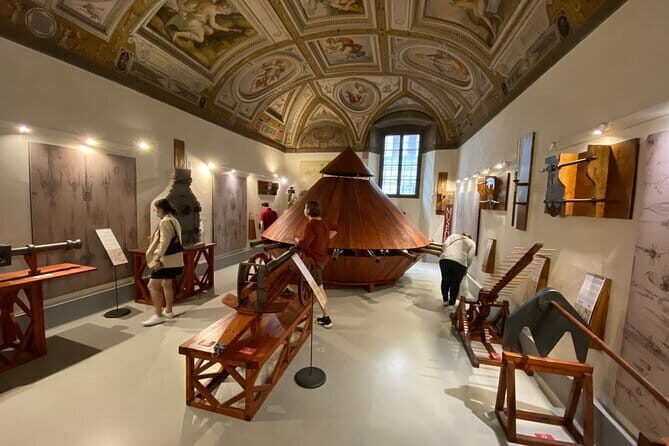
This is a straightforward admission ticket to the Leonardo da Vinci museum experience in Florence, offered in English, with entry tied to the time slot you select. It’s run by Museo Le Macchine di Leonardo da Vinci, and your ticket is what gets you inside the exhibition space.
What makes it appealing is the museum’s angle. Instead of treating da Vinci as only a painter, it leans hard into the engineering brain: mechanisms, concepts, and designs you can see as physical objects. The ticket cost is modest compared with many Florence attractions, which means you can spend less time budgeting and more time actually looking.
Also, the museum is not huge in time commitment. That matters because Florence days get packed. With about 1 hour to 1.5 hours on-site, you’re not stuck in a half-day sinkhole.
You can also read our reviews of more tours and experiences in Florence


Pre-booked entry and timing: fitting this into your day
You’re paying for one big practical thing: time savings. Florence is a city where lines can grow fast, especially around popular sights. Pre-booking your ticket helps you avoid those long waits at the door.
The museum runs Monday through Sunday, 10:00 AM to 6:00 PM (for the listed operating dates). With flexible time slots, you can pick an entry window that matches your day—late morning if you like calm streets, or early afternoon if you want a break from the sun.
One more detail that helps: the experience setup lists a maximum of 20 travelers, which usually translates to smoother entry and less crowd pressure once you’re inside. And since this is essentially an admission ticket, you can move at your own speed—reading, comparing models, and circling back without feeling rushed.
Quick practical tip: plan to arrive a few minutes early for your selected window. You’re not trying to sprint; you just want to get in before the room patterns get busy.
Your one-stop itinerary inside the Leonardo da Vinci museum
Unlike a multi-stop guided tour, this is a single museum visit. That’s good news if you want something focused. Here’s what your visit looks like once you’re inside Museo Leonardo Da Vinci.
The museum setting: Galleria Michelangelo and a “where art met art” vibe
The machines are displayed at Galleria Michelangelo, on a renowned street in Florence city centre. There’s also a neat historical texture to the location: the Macchiaioli used to meet nearby (the art movement linked to that group is part of Florence’s story).
That location detail isn’t just trivia. It makes the whole stop feel more grounded. You’re not popping into an anonymous building. You’re in the middle of the city’s creative geography, right where other artists and thinkers were drawn to gather.
Room layout overview: four themes, 50+ models, and working mechanisms
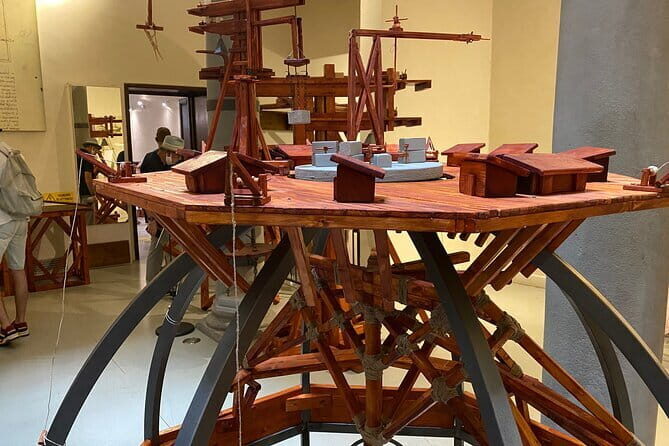
Across four rooms, you’ll see more than 50 da Vinci models. The key word in the museum description is working: most of the models are real working machines. That single phrase changes the experience.
When models move, click, or demonstrate a concept, your brain understands faster than when you’re only reading captions. You can trace how the parts relate instead of treating the display like a behind-glass photo.
The rooms are arranged by theme:
- Room 1: civil machines
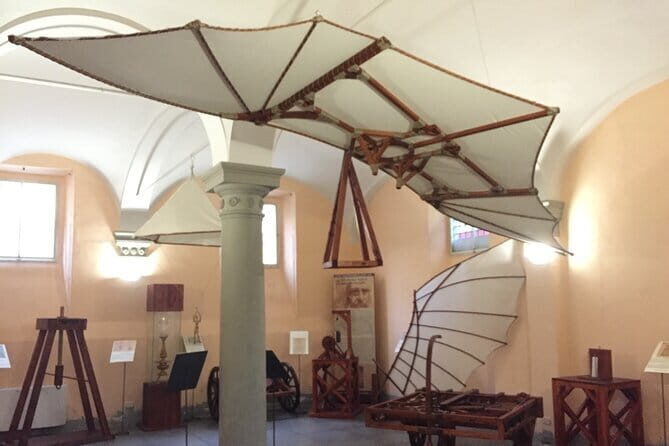
- Room 2: flying machines
- Room 3: war machines
- Room 4: anatomical models (described as recently developed in the information)
This structure is a big deal. You don’t wander randomly for an hour trying to guess what you missed. You move through a set of topics and your understanding gets more complete as the rooms progress.
You can also read our reviews of more museum experiences in Florence


Stop in Room 1: civil machines (engineering for everyday scale)
The first room focuses on civil machines. Think: the kind of inventions that connect to infrastructure—how people build, move materials, and solve practical problems.
This is a great room to start in because it frames da Vinci as a systems thinker. Even if you only catch a few concepts, you start to see patterns: how he thinks about forces, movement, and how parts interact.
If you’re a fan of real mechanisms, you’ll likely enjoy this room most. It tends to feel like engineering you can picture in modern terms, even when the designs look wildly creative.
Stop in Room 2: flying machines (ideas that feel like they should not work)
Next comes the flying machines. Da Vinci’s aviation concepts are the stuff of imagination, but this museum keeps the focus on the physical designs—so the visit feels less like myth and more like engineering hypotheses.
You’ll likely slow down here. Flying topics invite curiosity, and seeing models helps you connect sketches to concepts you can point at. It also helps families because kids usually react well to anything that looks like it could lift off.
Stop in Room 3: war machines (history without being just spectacle)
The war machines room is the third major section. Expect designs connected to defense or weapon concepts—still grounded in da Vinci’s engineering mindset.
This room can feel intense if you’re visiting with smaller kids. Still, it’s useful context for da Vinci’s broader range. He wasn’t only a dreamer; he was also thinking about how societies protect themselves and how technology changes conflict.
If you prefer gentler content, you can skim parts of this room and spend more time on the civil and flight sections.
Stop in Room 4: anatomical models (science meets observation)
Finally, anatomical models are presented in the fourth room, described as a recently developed collection. This is where da Vinci’s curiosity shifts from machines to the inside of the body.
I like this room because it broadens the visit. It’s one thing to admire invention. It’s another to see how serious his observation was—his attention to structure and function.
If you’re traveling with teens, this is often the room where their interest clicks into place. Even if they aren’t into mechanical gadgets, anatomy ties into biology, medicine, and human curiosity.
The documentary screens and how to use them (without losing time)
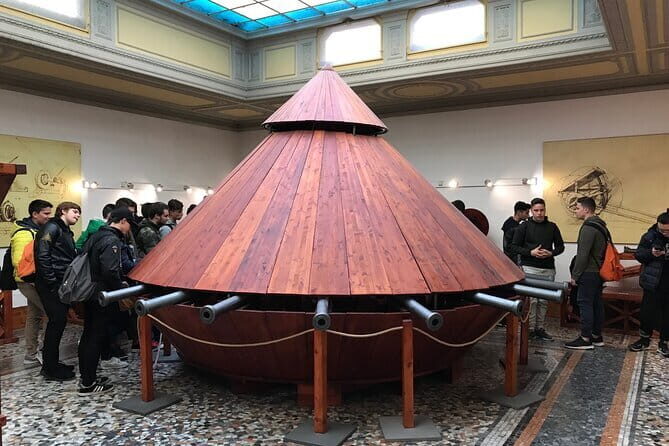
Alongside the room displays, there’s a documentary on Leonardo da Vinci’s life and works shown on large monitors. This is handy if you want context without needing a full guidebook.
My advice: treat the documentary as optional support, not homework. If you’re the type who reads every placard, you might only need a quick glance at the main points. If you’re short on reading time, use the documentary to set the big picture while you move from room to room.
Either way, it helps you connect what you’re seeing to the broader story of how da Vinci worked across disciplines—art, engineering, anatomy, and more.
Caffè Michelangiolo inside the exhibition area: take a breather
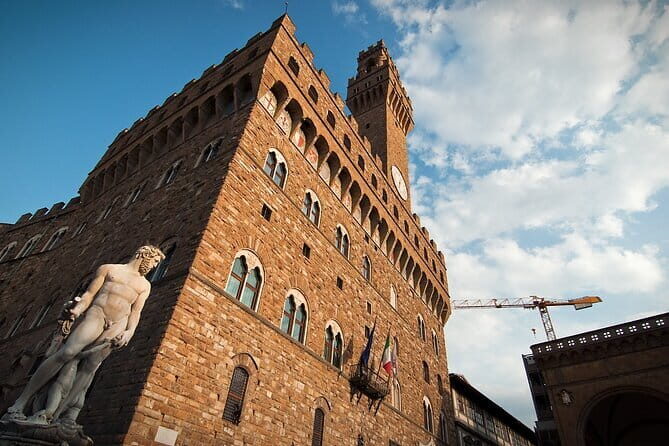
There’s an agreement with Caffé Michelangiolo, a restaurant inside the exhibition area. That matters because it means you won’t need to leave the museum to refuel if you’re hungry or if you’re traveling with kids.
Food and drinks are not included with the ticket, so you’ll pay separately. Still, having an on-site option makes the museum stop easier to manage, especially on a hot day when you’re trying to avoid a long walk just for water or gelato.
The gift shop and bookstore: worth a quick browse
The information includes a bookshop on-site, with publications and gadgets. This is a practical stop if you want a souvenir that’s actually related to what you just saw.
I like using museum shops this way: spend a few minutes there after the visit, not before. Then the products make sense. You’re buying with memory attached, not guessing what the store means by da Vinci gear.
If you’re traveling with kids, this is also one of the simplest ways to make the visit feel like a complete experience.
What you’ll learn from the machines (even if you only skim)

This museum’s value is not just that you see inventions. It’s that you see how ideas become parts, parts become mechanisms, and mechanisms become concepts you can understand.
A few themes stand out based on how the museum is arranged:
- Engineering logic: you can connect design to function
- Range: machines cover civil, flight, and military topics
- Scientific curiosity: anatomy adds the body-to-observation angle
- Translation of drawings to objects: the whole point is to help you bridge sketch concepts to physical design
If you like science museums, this fits that mood. If you prefer art history, you may still appreciate it, but you’ll need to adjust expectations: this is about da Vinci as an inventor more than as a painter.
Price and value in Florence: why $12.55 can work
At $12.55 per person, this isn’t a budget-buster in a city where many attractions are pricey. The real value question is time and focus.
For about 1 to 1.5 hours, you get:
- admission to a museum built around da Vinci inventions
- a structured path through four themed rooms
- models that are described as working machines
- a documentary that gives life context
Even if you end up only enjoying two rooms fully, the overall set still offers a satisfying hit of da Vinci’s thinking.
Is it perfect value for everyone? No. Some people expect a museum to feel like it has original artifacts and deep storytelling at every turn. If that’s your style, you might find parts of the experience less satisfying than you hoped. Still, for most people who want a compact, science-focused stop, the price-to-time ratio is strong.
Best for families, curious minds, and science lovers
This ticket is a good match if you fall into one of these categories:
- You want da Vinci through inventions and mechanisms, not only famous paintings
- You travel with kids and want a place where they can stay engaged with models and activities
- You like interactive-style exhibits and visual demonstrations
- You have about an hour and want something structured, not random
The museum is also described as having child-focused elements, including a kids area and hands-on style activity zones. That makes it easier to keep a mixed-age group moving without constant negotiation.
If you’re traveling solo or as a couple, it’s still a solid stop. You can focus on your favorite room (civil, flying, war, or anatomy) and take your time reading the descriptions at your own pace.
Who might feel disappointed (and how to avoid that)
I’d steer you toward caution if you want museum experiences built around authentic art objects or thick historical interpretation of paintings. The museum’s center of gravity is engineering models, and the overall feeling can be more instructional than artistic.
There’s also a practical risk for ticket buyers: Florence vs. other cities. The broader Leonardo da Vinci museum brand exists in multiple locations, and it’s possible to purchase the wrong one if you’re not careful. Before you finalize anything, double-check the Florence location name and your selected museum. This one-step check can save real stress.
Finally, keep expectations realistic about interactivity. The museum offers interactive-style experiences and working models, but it’s still a ticketed museum setting. Some parts are more hands-on in spirit (models that demonstrate) than in true free-play ways.
Should you book this Leonardo da Vinci Museum ticket?
Yes, if you want an hour of focused da Vinci invention viewing in Florence without paying big-tour prices. This is a smart value stop: $12.55, English, a clear room structure, and a visit length that doesn’t ruin your schedule.
I’d book it especially if you’re traveling with kids, like science and engineering topics, or want a different angle than the typical Florence art route. If you’re the type who needs original artworks and deep historical storytelling on every wall, you might want to pair this with an art-focused museum so your trip stays balanced.
If you’re ready for machines, models, and the kind of curiosity that makes your brain say wait, that’s possible, then get the ticket and give yourself that hour.
FAQ
How much is the Leonardo da Vinci Museum Entrance Ticket in Florence?
The price is $12.55 per person.
How long does the museum visit take?
The duration is about 1 hour to 1 hour 30 minutes.
Is the ticket offered in English?
Yes. The experience is offered in English.
What is included with the ticket?
The ticket includes admission to the Leonardo da Vinci Museum (Museo Le Macchine di Leonardo da Vinci).
What are the museum opening hours?
The museum is open daily, Monday through Sunday, from 10:00 AM to 6:00 PM.
Where is the Leonardo da Vinci museum located?
It’s in Florence, and the Leonardo da Vinci machines are displayed at Galleria Michelangelo in the city center. The listing notes it is near public transportation.
Can I choose a time slot?
Yes. The ticket offers flexible time slots throughout the day.
What is the cancellation policy?
Free cancellation is available up to 24 hours in advance for a full refund.
You Might Also Enjoy


More Museum Experiences in Florence
More Tickets in Florence


More Tour Reviews in Florence
- Tuscany Day Trip from Florence: Siena, San Gimignano, Pisa and Lunch at a Winery
★ 5.0 · 21,634 reviews - The Best tour in Florence: Renaissance & Medici Tales – guided by a STORYTELLER
★ 5.0 · 12,316 reviews