REVIEW · FLORENCE
Renaissance Explained Tour in Florence
Book on Viator →Operated by La Bussola Tours · Bookable on Viator
Florence gets explained in walking distance. This 2.5-hour Renaissance tour strings together big ideas and recognizable landmarks, then turns them into small hands-on moments—especially the linear perspective experiment in Piazza del Duomo. I also like how the guide keeps the story cohesive, so you understand why these places matter instead of just ticking them off.
I’m also a fan of the guide energy. On my tour, Aida brought serious affection for Brunelleschi and used it to connect the logic of Florence’s early Renaissance thinking to what you see in front of you. That kind of clarity makes the architecture feel less like homework and more like cause-and-effect.
One consideration: the pace is efficient. Many stops are only 2–20 minutes, so if you love lingering in one chapel or want to read every inscription, you may wish you had more time on your own after the tour.
In This Review
- Key highlights to look for
- A Renaissance story you can follow at walking speed
- Meeting at Piazza degli Strozzi, then easing into the lesson
- Stop 1: Go Giunti Odeon Liberia e Cinema and Leonardo’s angle
- Orsanmichele area: the Renaissance starts to show (from outside)
- A leather market stop: why crafts matter to Renaissance Florence
- Santa Maria del Fiore: a build story you can picture
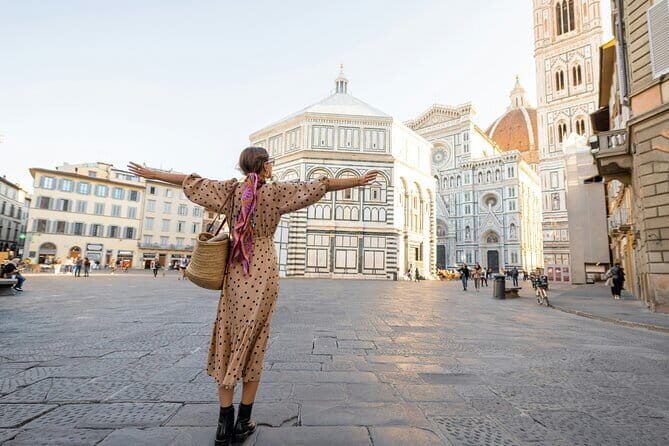
- Piazza del Duomo experiment: linear perspective made visible
- Baptistero exterior and the Paradise Gates overview
- Edoardo il Gelato Biologico: break time with hazelnut fame
- Museo Leonardo Da Vinci: Vitruvian Man, quickly explained
- Piazza della Santissima Annunziata and Museo degli Innocenti
- Inside Basilica della Santissima Annunziata: Renaissance gives way to Baroque
- Price and value: what $93.62 gets you in Florence
- Who this Renaissance Explained tour suits best
- Should you book this Florence Renaissance Explained Tour?
- FAQ
- How long is the Renaissance Explained Tour in Florence?
- Is the tour offered in English?
- Is this a private tour?
- Where do I meet, and where does the tour end?
- Are admission tickets included for the stops?
- Is there time for gelato?
- What is the cancellation policy?
Key highlights to look for
- Linear perspective made practical in Piazza del Duomo, not just explained
- Aida’s Renaissance-to-Baroque story keeps the route feeling like one narrative
- Leonardo da Vinci stops that connect ideas like the Vitruvian Man to the Renaissance
- Orsanmichele and Baptistero viewpoints that frame Florence’s sculpture and symbolism
- Gelato break at Edoardo il Gelato Biologico (great hazelnut reputation)
- Santissima Annunziata inside visit with an explicit Renaissance-to-Baroque transition
A Renaissance story you can follow at walking speed
This is the kind of Florence tour that helps you get your bearings fast. You start near Piazza Strozzi, then you move into a route that traces how Renaissance thinking worked—geometry, proportion, sculpture, and “how humans should read space.” The value isn’t just that you see major sights. It’s that you get the mental map to understand them in order.
The tour is private, so your group stays together the whole time. That matters in Florence, where timing and foot traffic can scramble plans. With a start time of 2:30 pm and an overall length around 2 hours 30 minutes, you can fit it into a day that already includes museums and meals.
The price—$93.62 per person—puts this in the “you’re paying for a strong guide” category. Here, that’s the point. You’re not paying for long museum time. You’re paying for interpretation, clear connections, and a guide who can explain why the Renaissance changed art and architecture (and why Florence had such an outsized role).
You can also read our reviews of more tours and experiences in Florence.
- Tuscany Day Trip from Florence: Siena, San Gimignano, Pisa and Lunch at a Winery
★ 5.0 · 21,634 reviews
Meeting at Piazza degli Strozzi, then easing into the lesson
You meet at Piazza degli Strozzi (Piazza Strozzi), 50123 Firenze. It’s a good launch spot because it’s close enough to the action to feel efficient, but not so close to the busiest hubs that you feel stressed right away.
From the start, the guide’s job is to frame what you’re seeing. You’ll learn quickly what you should notice—details about form, placement, and how Renaissance ideas show up in multiple places. The route ends at the SS. Annunziata area, and it’s about a five-minute walk from the Cathedral area, which is handy if you want to keep exploring afterward.
Because many stops are short, I recommend treating this like a guided “first read” of Florence. Then, if something catches your eye—especially the Duomo zone or Santa Maria della Scala—you can return on your own with fresh context.
Stop 1: Go Giunti Odeon Liberia e Cinema and Leonardo’s angle
The tour kicks off with an internal visit to a cinema dedicated to Leonardo da Vinci: Go Giunti Odeon Liberia e Cinema. Expect this stop to be concept-first. You’re not going to spend an afternoon inside a theater, but you’ll get a quick entry point into Leonardo’s influence and why his ideas still connect to Renaissance curiosity.
This is a smart opener. It signals that this isn’t only about stone and frescoes. The Renaissance was also about thinking—observation, design, and how knowledge moves between science and art. If you like Leonardo as more than a famous name, this first taste helps.
Downside? Since it’s a short stop (about 20 minutes) you won’t leave with encyclopedic knowledge. But that’s not what this tour is built for. It’s built to build understanding fast.
Orsanmichele area: the Renaissance starts to show (from outside)
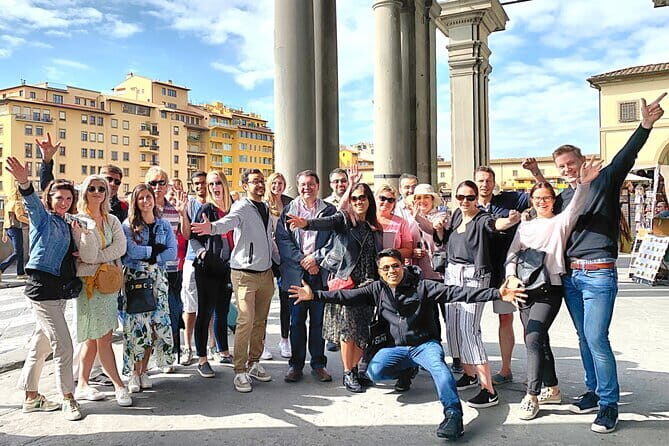
Next comes the Church and Museum of Orsanmichele. You’ll have an exterior-focused moment aimed at seeing the first Renaissance statue. This is one of those stops where your guide’s framing does most of the work. The Renaissance often shows up as a change in style and intention—how artists create believable form, balance, and meaning.
Orsanmichele sits in a place where Florence’s craft and symbolism overlap, so it’s a good site for the tour to explain what changes during the rebirth period. The stop is about 15 minutes, which means it’s a quick “look and learn” session rather than a deep museum visit.
If you’re a true sculpture nerd, you’ll likely want more time inside other sites later. Still, as part of a story-based route, this works well.
A leather market stop: why crafts matter to Renaissance Florence
Mid-route you’ll see one of the two main leather markets in Florence. This might feel like a detour if you’re expecting only monuments, but it makes the tour feel real. Renaissance art didn’t appear in a vacuum. Cities like Florence depended on skilled trades, guild culture, and the practical economies that supported artists.
This stop is also a reminder that “Renaissance” is not just a style. It’s a way of life—work, design, production, and the value of making things well.
The only catch is time. You’ll get the window, not a full lesson in Florentine commerce. But that’s enough for you to connect the city’s physical world to the art you’re seeing.
- Tuscany Day Trip from Florence: Siena, San Gimignano, Pisa and Lunch at a Winery
★ 5.0 · 21,634 reviews

Santa Maria del Fiore: a build story you can picture
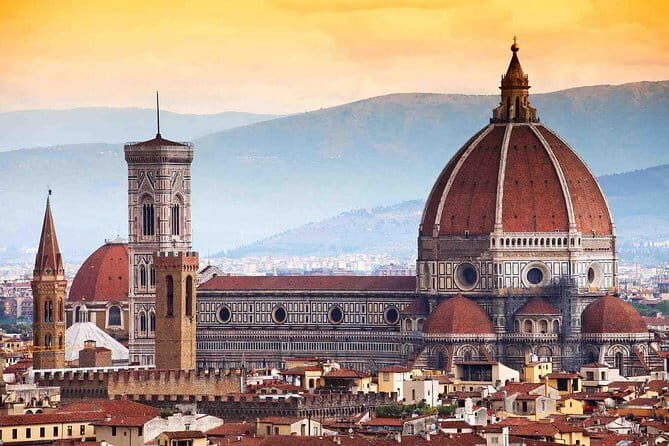
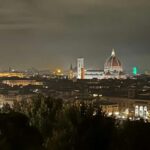
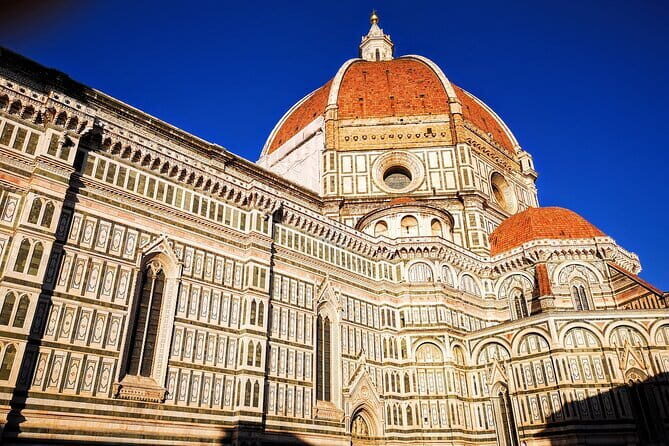
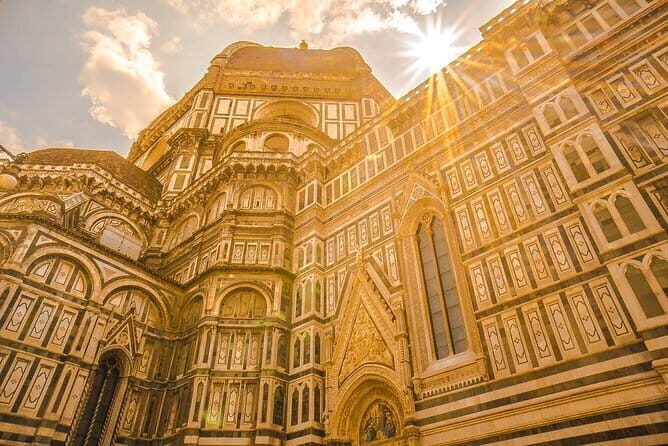
Then you reach the Cathedral of Santa Maria del Fiore for an outdoor visit with an entertaining story about how the cathedral was built. The stop is around 10 minutes, so the goal is not exhaustive architecture history. It’s to help you understand the building as a project—something constructed through time and ideas, not as a single instant.
What makes this stop useful is that the story sets you up for the next location. You’ll start noticing space, structure, and the logic behind visual effects. Even if you’ve seen photos of the Duomo, hearing how it came together changes how you look at it.
Because it’s outdoors, it also fits well into real-day Florence conditions. If weather shifts, you’re not stuck waiting for a closed interior.
Piazza del Duomo experiment: linear perspective made visible
The best “hands-on” moment arrives in Piazza Del Duomo. Here, you’ll replicate an experiment that brought linear perspective to life. The stop is about 20 minutes, and this is exactly the kind of tour activity that helps the Renaissance click.
Linear perspective is one of those ideas that sounds abstract until you see how it behaves with your eye. This exercise turns theory into something you physically grasp—how lines, proportions, and viewpoint create the illusion of depth. Once you understand the trick, Renaissance paintings and building facades start to make more sense everywhere you go.
If you like architecture, geometry, or just want to feel clever for a moment, this is the standout stop. It also works for beginners, because the guide’s job is to explain in plain terms.
Baptistero exterior and the Paradise Gates overview
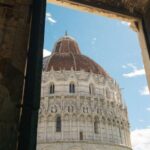
Next is the Battistero di San Giovanni, with an exterior overview of the famous Paradise Gates. The stop is about 8 minutes, which means the guide gives you the most important visual idea: what you should recognize, and why the gates matter.
This is a good “reset” stop. After the perspective experiment, you now shift back to symbolism and sculpture—how Renaissance artists and patrons used imagery to communicate values. The short duration keeps it from becoming a lecture, and you still get enough direction to appreciate what you’re looking at.
If you want closer views and more detail, you’ll likely want to return later. But for this tour’s story structure, the quick overview does its job.
Edoardo il Gelato Biologico: break time with hazelnut fame
You then get a gelato break at Edoardo il Gelato Biologico – Gelateria Piazza Duomo. The stop runs about 20 minutes and the guide highlights it as famous for hazelnut flavor, with plenty of other options and affogato.
This is more than a snack. It’s a good pacing tool in a tour packed with ideas. You’ll also be in a prime location to take a breather while still staying near the Duomo zone.
Practical note: the tour data doesn’t explicitly say your gelato is included. Plan on paying for your own. The upside is that you can choose what you actually want, not what a package deal forces on you.
Museo Leonardo Da Vinci: Vitruvian Man, quickly explained
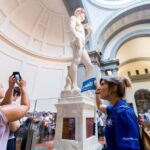
After the gelato, you stop at Museo Leonardo Da Vinci for a Vitruvian Man explanation. This one is only about 5 minutes, so it’s a focused hit, not a long exhibit.
But that short time can still be effective, because the Vitruvian Man is the Renaissance idea machine in sketch form: human proportion, geometry, and the belief that art and science belong in the same conversation. If you’ve seen the image before, the guide’s explanation helps you connect it to the wider Renaissance theme the tour is building.
If you want more time with Leonardo’s influence, this tour can act like a preview. You’ll know what to look for when you go back on your own.
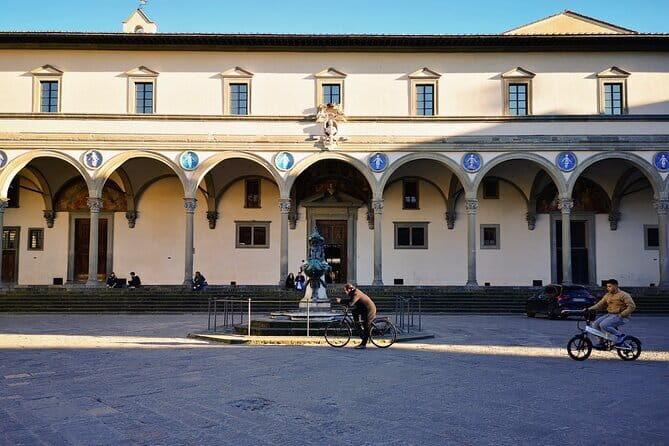
Piazza della Santissima Annunziata and Museo degli Innocenti
Now the route shifts into the Santissima Annunziata area, which the tour frames as a key “first Renaissance” location. You’ll spend about 2 minutes at Piazza della Santissima Annunziata, and then about 5 minutes at the Museo degli Innocenti, focused on understanding Renaissance architecture next to the First Renaissance building.
Even though these stops are brief, the timing works. The tour is teaching you that Renaissance isn’t only about iconic giants like the Duomo. It’s also about planning, civic space, and how architecture communicates order.
If you love cities where the urban design is part of the story, you’ll appreciate this shift. Florence becomes more readable when you see how public squares and building forms fit into the Renaissance worldview.
Inside Basilica della Santissima Annunziata: Renaissance gives way to Baroque
The final act is inside Basilica della Santissima Annunziata – Chiesa di Santa Maria della Scala. This is an interior visit with an explanation of the passage from Renaissance to Baroque, and it’s about 20 minutes.
This stop is the payoff for the route’s pacing. You’ve already learned how Renaissance thinking worked—geometry, proportion, and the logic of form. Then the guide explains the transition toward Baroque, where expression, drama, and emotional impact become more central.
The tour also describes this as the most beautiful church in the city, so it’s built as a memorable ending. Even if you’re skeptical of superlatives, the structure of the tour makes the claim make sense. It’s a finale designed to leave you feeling like you understand what changed, not just where to stand.
Price and value: what $93.62 gets you in Florence
Here’s the value question. For $93.62, you’re not buying long-time access to dozens of interiors. You’re buying:
- An excellent English guide and cohesive storytelling
- A route that links concepts across monuments and neighborhoods
- Short, intentional stops that keep the theme moving
- Special beats like the cinema visit and the linear perspective experiment
- Private tour format, so your group isn’t mixed and delayed
This can be an especially good deal if you’re the kind of traveler who wants “explain it to me” help. If you’d rather wander independently with a guidebook, you might find the stop lengths limiting. But if you want a guided narrative that turns Florence into a readable story, the price feels justified.
Also, this tour is often booked about 13 days in advance on average. If you have fixed plans, I’d reserve early—especially since afternoon slots can fill.
Who this Renaissance Explained tour suits best
I’d point you toward this tour if you:
- Love art and architecture but get frustrated by lists of facts without connections
- Want to understand Florence’s Renaissance influence on world culture through a guided storyline
- Enjoy learning moments that use your body and eye, like the perspective experiment
- Prefer a private format where the guide can keep momentum without crowd-control chaos
If you’re traveling with someone who thinks Renaissance means only paintings and sculpture, this tour gives them a more complete picture—Leonardo, proportion, craft economy, and the shift toward Baroque.
Should you book this Florence Renaissance Explained Tour?
Book it if you want Florence explained like a story, with enough hands-on moments to make the ideas stick. The strengths are clear: Aida’s passionate way of connecting Renaissance thinking to what you see, the linear perspective activity, and the satisfying arc from early Renaissance to Baroque.
Skip it only if you mainly want deep time inside museums and churches. This is not built for long lingering. It’s built for clarity and momentum—so you leave with a stronger map of the city and a better understanding of why these buildings shaped art far beyond Florence.
FAQ
How long is the Renaissance Explained Tour in Florence?
It’s about 2 hours 30 minutes.
Is the tour offered in English?
Yes, the tour is offered in English.
Is this a private tour?
Yes. It’s a private tour/activity, and only your group participates.
Where do I meet, and where does the tour end?
You meet at Piazza degli Strozzi (Piazza Strozzi, 50123 Firenze). The tour ends at the SS. Annunziata di Firenze, P.za della SS. Annunziata (a 5-minute walk from the Cathedral zone).
Are admission tickets included for the stops?
The tour information lists admission tickets as free for each stop.
Is there time for gelato?
Yes. There’s a gelato break at Edoardo il Gelato Biologico – Gelateria Piazza Duomo, about 20 minutes.
What is the cancellation policy?
You can cancel for free up to 24 hours in advance for a full refund. Changes made less than 24 hours before the start time aren’t accepted. If a minimum traveler count isn’t met, you’ll be offered a different date/experience or a full refund.
You Might Also Enjoy
More Tours in Florence
- The Best tour in Florence: Renaissance & Medici Tales – guided by a STORYTELLER
★ 5.0 · 12,316 reviews

More Tour Reviews in Florence
- Tuscany Day Trip from Florence: Siena, San Gimignano, Pisa and Lunch at a Winery
★ 5.0 · 21,634 reviews - The Best tour in Florence: Renaissance & Medici Tales – guided by a STORYTELLER
★ 5.0 · 12,316 reviews