REVIEW · FLORENCE
Heart of Florence Guided Walking Tour
Book on Viator →Operated by CAF Tour and Travel · Bookable on Viator
Florence can feel like a maze at first. This guided walk gives you the key sights in a smart, hour-and-a-half route. I love that you start right by the Duomo complex and end on Ponte Vecchio, so the trip naturally shapes how you understand the city.
Two things I especially like: you’ll get a tight explanation of the monuments (not just a list), and the route hits both “famous postcards” and the places where Florentines actually move through daily life. One drawback to consider is that several stops involve areas where admission tickets aren’t included, so you’ll want to decide in advance whether you care about going inside.
With the right shoes and a little curiosity, this is a simple way to get your bearings fast and still feel like you’ve seen the real Florence.
In This Review
- Key things to know before you go
- Where the tour starts: Duomo area orientation in 10 minutes
- Palazzo Medici Riccardi and San Lorenzo: the Medici story in street scale
- Piazza San Giovanni and the Duomo complex: seeing the pieces, not just the icon
- Orsanmichele church and museum: Gothic art from the trade-guild angle
- Mercato del Porcellino: local superstition and a quick reset
- Piazza della Signoria: the outdoor museum effect (without the confusion)
- Ponte Vecchio: finishing with the postcard you’ll actually remember
- Price and value: what $30.04 buys you in real terms
- Lunch option: a 3-course break in Florence’s center
- Hearing the guide: English, headphones, and seasonal language notes
- Who this tour fits best (and who should skip it)
- Should you book this Heart of Florence guided walk?
- FAQ
- How long is the Heart of Florence guided walking tour?
- Where does the tour start, and where does it end?
- What’s included in the tour price?
- Is there an optional lunch, and what does it include?
- Does the tour include tickets for the Duomo and other sites?
- What language is the tour offered in?
- Are headphones provided?
- How large is the group?
- What’s the cancellation policy?
Key things to know before you go
- Small group up to 20 people means the pace stays manageable and you’re not stuck in a huge crowd.
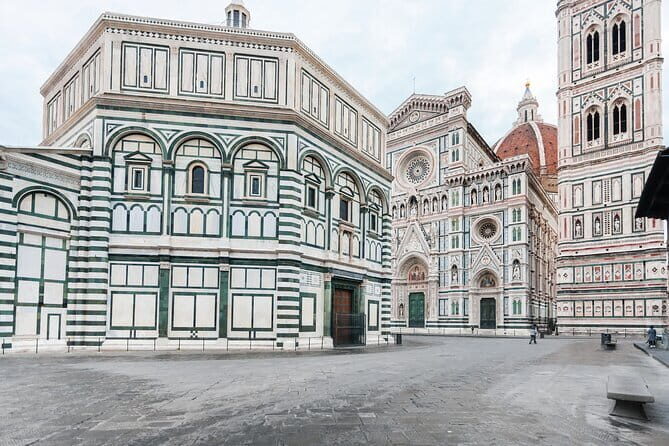
- Duomo + Baptistery views are the opening act, including the Dome of Brunelleschi, Giotto’s bell tower, and Ghiberti’s Porta del Paradiso.
- Orsanmichele adds Gothic art details you might miss wandering alone.
- Piazza della Signoria becomes an outdoor art-and-politics lesson, with stops around Neptune’s Fountain and the Loggia dei Lanzi.
- Headphones for groups over 10 help keep the guide easy to hear in the busy center.
- Optional Tuscan lunch is a 3-course set menu if you add it on.
Where the tour starts: Duomo area orientation in 10 minutes
The tour meets in Florence’s historic core near the Duomo area, with the given start address at Via de’ Martelli, 50, and the meeting time listed at 2:45pm near Piazza del Duomo. Either way, you’re starting in the part of town where everything important feels close—but it’s also the place where first-timers can lose time and direction fast. This is why I like this tour format: the route begins where your “mental map” needs to form.
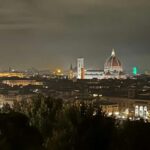
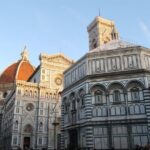
From the start, you stand close enough to actually study the architecture. You’re meant to look at Brunelleschi’s Dome and Giotto’s Campanile up close, not from a distance. That matters because these buildings are designed like visual arguments. Up close, you can see how Florentine craftsmen turned engineering and symbolism into something you can feel.
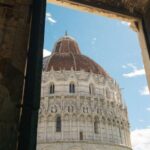
You’ll also pick up context for the Baptistery of St. John, including the Porta del Paradiso bronze doors by Lorenzo Ghiberti. Even if you don’t go inside (tickets aren’t included for this complex), just knowing what you’re looking at changes the whole experience.
Practical tip: Churches and historic monuments often require appropriate clothing, so I’d plan for shoulders and knees if you’re heading straight from sightseeing.
You can also read our reviews of more walking tours in Florence
Palazzo Medici Riccardi and San Lorenzo: the Medici story in street scale
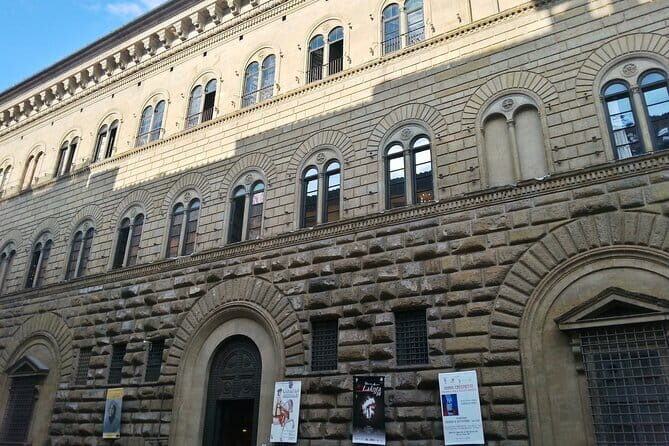
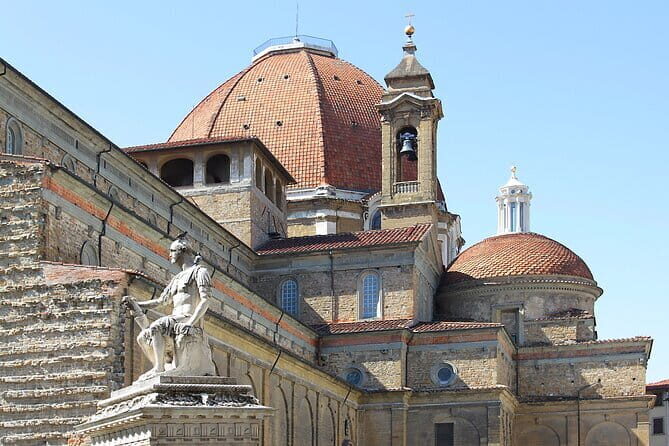
Early in the walk, you visit the Palazzo Medici Riccardi, the first major residence associated with the Medici family, located in the San Lorenzo district. Admission isn’t included here, so this is more of an exterior-and-explanation stop than a “go inside right now” moment. Still, I think it’s a valuable start, because the Medici influence isn’t some abstract schoolbook topic—you see it in how power wanted to look in Florence.
Next is Piazza di San Lorenzo, a central square surrounded by historic buildings, with a lively market feel and the nearby anchor of San Lorenzo Church. This stop is short, about 10 minutes, but it serves an important purpose: you shift from monument scale (Duomo complex) to everyday city life. It’s the kind of pause that helps the rest of the walking tour make sense. Florence isn’t only marble and domes; it’s also trade, daily routines, and neighborhood energy.
If you’re the type who likes to understand why things are where they are, this part helps you connect the political/religious center to the commercial heart.
Piazza San Giovanni and the Duomo complex: seeing the pieces, not just the icon
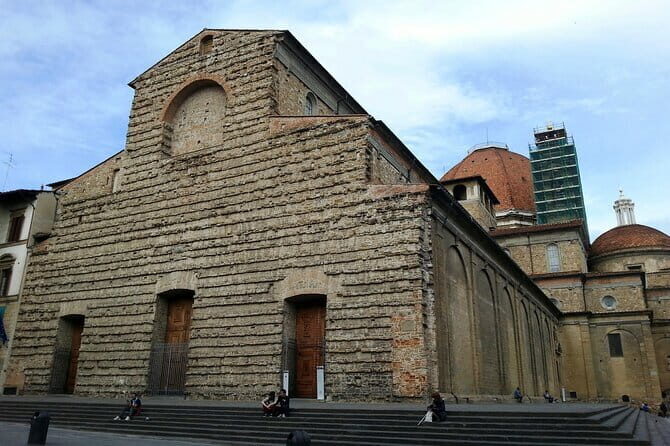
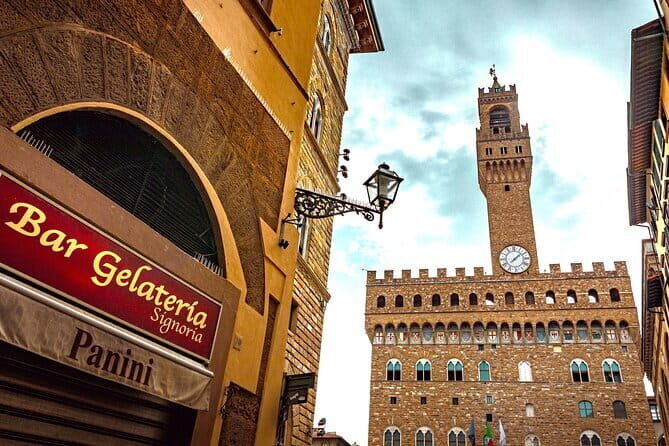
The next major focus is Piazza San Giovanni, the famous square where the Cathedral complex dominates the view. Here you’re meant to appreciate the full set: the Cathedral (Cattedrale di Santa Maria del Fiore), the Baptistery, and Giotto’s bell tower.
Then you spend time specifically at the Duomo complex with an emphasis on what makes Florence’s religious center different from many other European cities. You’ll hear what to look for in:
- Brunelleschi’s dome and its engineering impact
- The Baptistery of San Giovanni and the Porta del Paradiso
- Giotto’s bell tower, often described as one of the most beautiful in Italy
Admission tickets here are listed as not included, so don’t plan your schedule like you’re guaranteed to enter. Instead, treat this as a “masterclass on what you’re seeing outside.” If you want interiors, you can usually buy tickets separately—but that choice is yours.
Why this matters: If you only ever catch these sights from far away, Florence can blur into one big photo opportunity. This tour helps you notice details, and details are what stick.
Orsanmichele church and museum: Gothic art from the trade-guild angle
One of the most interesting stops on the route is Orsanmichele, a Florentine Gothic standout. It’s about a 10-minute stop, and admission tickets aren’t included. That means you’re not here for a long museum session. Instead, you’re here to understand what this building represents and why it looks the way it does.
Orsanmichele is tied to medieval trade guilds, and the decoration includes shrines and statues connected to powerful guild patron saints. For me, this is the kind of place where a guide earns their keep: without context, you might see beautiful stonework and miss the social meaning behind it.
If your interest leans toward how art and politics worked together in the Renaissance, this stop will feel satisfying—even in a short time window.
Mercato del Porcellino: local superstition and a quick reset
Next comes Mercato del Porcellino, where you’ll find the famous porcellino pig statue. The ritual here is simple: rub the nose and toss a coin into the fountain for good luck. This is one of those classic Florence moments that doesn’t need a long explanation—but I like having the moment guided anyway, because it turns a random photo stop into something you feel part of.
This stop is also a helpful pacing reset. You’ve just spent time in the emotional intensity of grand churches and civic squares. Now you drop back into a human-scale market setting, and you’ll likely feel the contrast in how the city sounds and moves.
What I’d do: If you want photos, take them quickly when the group pauses. The area gets busy and you don’t want to hold up the line.
You can also read our reviews of more guided tours in Florence
- The Best tour in Florence: Renaissance & Medici Tales – guided by a STORYTELLER
★ 5.0 · 12,316 reviews
Piazza della Signoria: the outdoor museum effect (without the confusion)
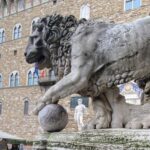
Piazza della Signoria is the heart of the walk’s civic section. It’s described as one of Florence’s best-known squares and a kind of outdoor museum. This stop is another 10 minutes, so the guide focuses on the most important objects and what they mean.
You’ll see major landmarks such as:
- Fountain of Neptune by Bartolomeo Ammannati
- Loggia dei Lanzi
- Arnolfo di Cambio
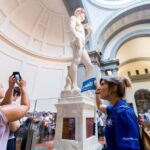
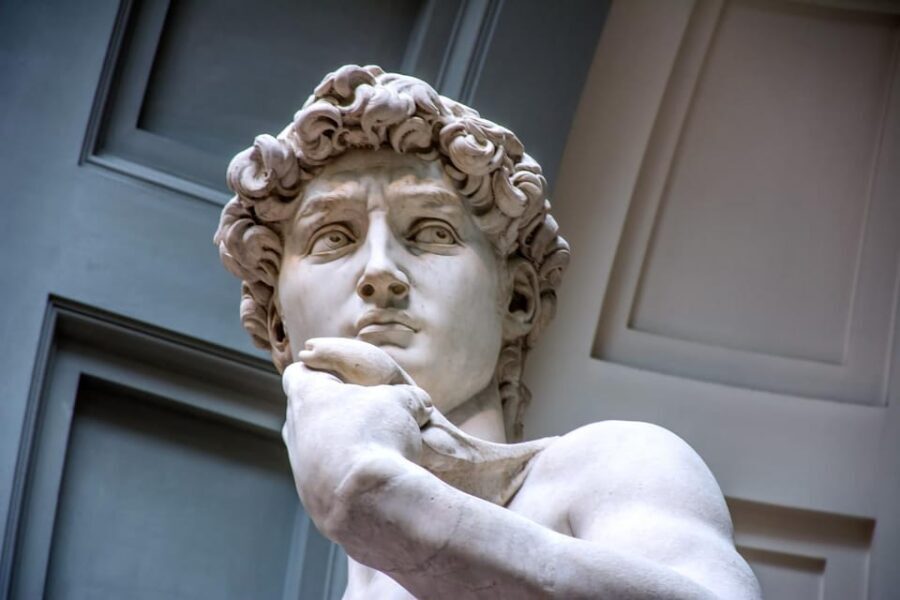
- A replica of Michelangelo’s David (since the original is elsewhere)
What you’re really learning here is how art functioned as political messaging. Even the arrangement of sculptures and architectural spaces helps explain Florentine power—who commissioned what, and how public art created a visible narrative.
This is one of the stops where I think having a guide is most worth it. If you walk this square on your own, it’s pretty—but it can also feel like too many objects with no story thread. The tour gives you that thread so the square reads like a page, not a pile of monuments.
Ponte Vecchio: finishing with the postcard you’ll actually remember
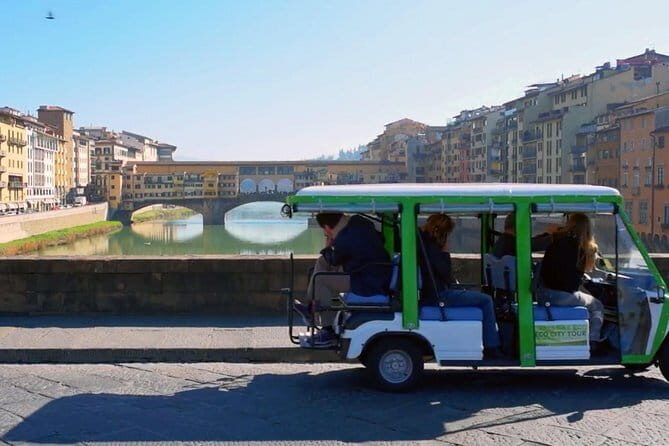
The tour ends at Ponte Vecchio, Florence’s oldest and most famous bridge. This is where you get your final view payoff: the bridge’s setting and the sense of moving from one “Florence world” (politics, religion, art) to another (everyday city life along the river).
Ponte Vecchio is also the kind of place that can feel crowded and touristy if you only treat it like a photo location. Finishing here helps, because by the time you reach it you understand why the bridge mattered. It becomes less of a generic stop and more of a conclusion to your mental map.
If you have 20 minutes after the tour: Hang around near the river. You’ll get a calmer look than you had while the group was moving.
Price and value: what $30.04 buys you in real terms
The price is listed as $30.04 per person for about 1 hour 30 minutes. That’s a straightforward cost for a city like Florence, where guided time can become expensive quickly.
Here’s the value logic I see:
- You’re paying for a guide who connects multiple major sights into a single, logical route.
- You’re getting help with how to look at architecture and sculpture—especially around the Duomo complex and Piazza della Signoria—where context makes a huge difference.
- You’re also getting small group structure (max 20 travelers) which helps you actually hear and ask questions.
The only cost “gotcha” to keep in mind: admission tickets are not included for several key stops (Palazzo Medici Riccardi, Duomo complex, and Orsanmichele). So your all-in cost can rise if you decide you want interiors. If you’re fine with seeing exteriors and getting explanations, the price stays strong.
Lunch option: a 3-course break in Florence’s center
If you select the lunch option, you can add a traditional Tuscan lunch. It’s described as a 3-course set menu, with drinks paid on the spot. Lunch is optional, but it can be a smart move if your day needs a scheduled reset.
Also worth noting: for the lunch option, 0–5 years old are noted as paying on the spot. That’s specific enough to plan around, so if you’re traveling with very young kids, I’d factor that into your day’s budget.
The lunch option is especially useful if you’re doing this walking tour early in your exploration and want something structured afterward without hunting for a meal in the crush.
Hearing the guide: English, headphones, and seasonal language notes
This tour is offered in English and you’ll receive confirmation at booking. For months April to October, the tour is described as monolingual (and in your case that would typically mean English). For November 1st 2024 to March 31st 2025, Spanish language is noted with a minimum of 4 participants.
There’s also a practical note that the guided service may be exceptionally provided in two languages due to operational reasons. That’s useful to know if you’re traveling with someone who cares about perfect comprehension.
Headphones are provided for groups of over 10 participants. That’s a big deal in Florence. Even if you’re close to the guide, the streets and piazzas can swallow voices. Headphones keep the tour from turning into guesswork.
My tip: If you’re the kind of person who likes to ask questions, stand near the guide when the group pauses. Your chance to hear the explanations and respond stays higher.
Who this tour fits best (and who should skip it)
This Heart of Florence walk works best if:
- You’re on a first trip and want a clear starter route that links major landmarks.
- You like getting the story behind the big sights, especially Duomo complex details and what sculptures in Piazza della Signoria signal.
- You prefer walking with a guide instead of building a plan yourself.
It may not fit as well if:
- You want long museum or interior time. Tickets aren’t included for several stops, and each location gets roughly 10 minutes.
- You hate walking. The route is compact, but it’s still a walking tour, and comfortable shoes are suggested.
- You’re only interested in one or two icons and would rather spend your time deeper inside venues.
Should you book this Heart of Florence guided walk?
Yes, if your goal is to understand Florence quickly. For about $30 and around 90 minutes, you get a guided route that connects the Duomo area to Orsanmichele, Market culture, Piazza della Signoria, and then ends on Ponte Vecchio—a sequence that builds a real mental map.
I’d book it especially if you value context over long waits. The stops are short, but the guide-focused explanation turns those short pauses into something you’ll remember later when you’re back in the streets on your own.
If you’re aiming to spend most of your time entering buildings, consider pairing this with ticketed time afterward (since admissions at key stops are not included). But as an efficient, story-driven orientation walk, this is a strong pick.
FAQ
How long is the Heart of Florence guided walking tour?
The tour is approximately 1 hour 30 minutes.
Where does the tour start, and where does it end?
You’ll meet in the Duomo area in Florence’s historic center, with the listed start address Via de’ Martelli, 50, 50122 Firenze FI, Italy. The tour ends at Ponte Vecchio, 50125 Firenze FI, Italy.
What’s included in the tour price?
Included are a local professional guide, small group tour, optional Tuscan lunch (if selected), multilingual assistance at the meeting point, and headphones for groups over 10. Admission tickets for some stops are not included.
Is there an optional lunch, and what does it include?
Yes. If you choose the lunch option, it includes a 3-course set menu with drinks paid on the spot. The lunch is in the very heart of Florence.
Does the tour include tickets for the Duomo and other sites?
Not automatically. Admission tickets are listed as not included for stops such as Palazzo Medici Riccardi, Duomo (Cattedrale di Santa Maria del Fiore), and Church and Museum of Orsanmichele.
What language is the tour offered in?
The tour is offered in English. From April to October, it’s described as monolingual. From November 1st 2024 to March 31st 2025, Spanish language is confirmed with min 4 participants.
Are headphones provided?
Yes—headphones are provided for groups of over 10 participants.
How large is the group?
This tour has a maximum size of 20 travelers.
What’s the cancellation policy?
You can cancel for a full refund if you cancel up to 24 hours before the experience’s start time. If you cancel less than 24 hours before, the amount paid is not refunded.
You Might Also Enjoy

More Walking Tours in Florence
More Tours in Florence
- The Best tour in Florence: Renaissance & Medici Tales – guided by a STORYTELLER
★ 5.0 · 12,316 reviews

More Tour Reviews in Florence
- Tuscany Day Trip from Florence: Siena, San Gimignano, Pisa and Lunch at a Winery
★ 5.0 · 21,634 reviews - The Best tour in Florence: Renaissance & Medici Tales – guided by a STORYTELLER
★ 5.0 · 12,316 reviews