REVIEW · FLORENCE
Private Guided Tour of Florence Basilicas and Their Cloisters
Book on Viator →Operated by CAF Tour and Travel · Bookable on Viator
Three churches, zero chaos. You’ll follow a private guide through Florence’s most story-rich basilicas and cloisters, with the Medici arc as your thread.
I love the way this route pairs top-tier art with the quieter spaces around it—Giotto, Masaccio, Donatello, plus the cloisters where symbols become easier to read. I also love the comfortable pace and clear explanations, with guides like Alessandra or Florence-born Gabrielle who keep the walk-and-talk plan smooth for different ages.
One possible drawback: it’s only about 3 hours, so you’re getting a smart overview rather than an hour-by-hour study of each chapel and fresco. Also, the big basilica entries are ticketed, so you’ll want to budget extra on the day.
In This Review
- Key points to know before you go
- A stress-free Florence route from Santa Maria Novella to Santa Croce
- Start at Santa Maria Novella and spot Alberti’s white-and-green façade
- Practical note
- The Green Cloister: where the cloister becomes the lesson
- San Lorenzo’s Old Sacristy and Brunelleschi’s Canons Cloister
- Why this stop is worth your time
- Practical note
- Piazza del Duomo and Piazza della Signoria for Medici context
- Practical note
- Santa Croce: Gothic marble, Donatello, and three legends in tomb form
- Finish with Brunelleschi’s cloisters and the Pazzi Chapel
- Practical note
- How much time you get, and what to do next
- Price and tickets: where the money goes for a private basilica tour
- Is it value?
- Who this tour suits best in Florence
- Should you book this private Florence basilicas and cloisters tour?
- FAQ
- What’s the duration of the tour?
- What language is the tour offered in?
- Is this tour private?
- Where do you meet, and where does the tour end?
- Are the basilica admission tickets included in the price?
- Does the tour include earphones?
- Can I cancel for a full refund?
Key points to know before you go
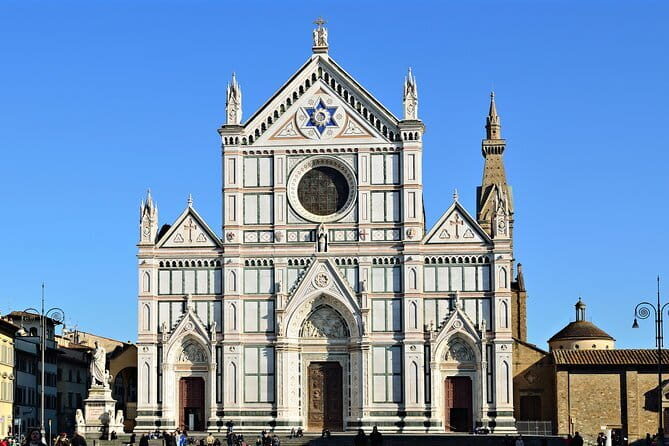
- Private guide, only your group: no weaving around strangers.
- Santa Maria Novella hits multiple eras fast: Alberti’s façade, Giotto Crucifix, Masaccio Trinity.
- Green Cloister murals by Paolo Uccello: a signature cloister experience using green-earth pigment.
- San Lorenzo is Brunelleschi through and through: Old Sacristy plus the Cloister of the Canons and the Medici orange tree.
- Medici storytelling in the open air: Piazza del Duomo and Piazza della Signoria add context between interiors.
- Santa Croce finale with big names in stone: frescoes, Donatello works, and tombs of Michelangelo, Galileo, and Machiavelli.
A stress-free Florence route from Santa Maria Novella to Santa Croce
Florence can feel like a choose-your-own-adventure city. This tour is the opposite: it’s a guided line through five major stops that keeps you oriented and moving without guesswork.
You start at Basilica of Santa Maria Novella at 10:00 am, then finish at Santa Croce. That one-direction flow matters because cloisters and basilicas are spread out, and time inside is precious. At about 3 hours total, you’ll get a concentrated experience that works well for first-timers and anyone short on daylight.
This is a private tour, so it’s only your group. If your group is larger, you’ll also have earphones (the tour provides them for groups over 7). And if you like straightforward tech, there’s a mobile ticket included.
You can also read our reviews of more guided tours in Florence
- The Best tour in Florence: Renaissance & Medici Tales – guided by a STORYTELLER
★ 5.0 · 12,316 reviews
Start at Santa Maria Novella and spot Alberti’s white-and-green façade
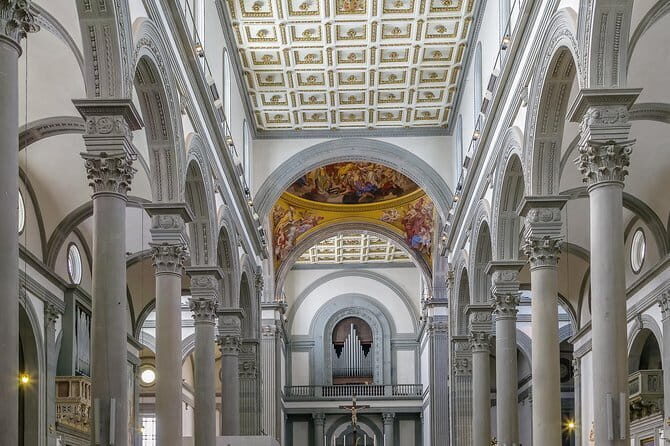
Santa Maria Novella is a great first stop because it gives you both Renaissance power and medieval roots right away. You’ll meet your guide outside the basilica, facing the striking façade designed by Leon Battista Alberti, built with white and green marble.
Inside, the church was founded by the Dominican Fathers at the beginning of the 1200s. That timeline helps you understand why the art doesn’t feel like one “style” era, but a conversation across centuries. If you’ve seen other Italian churches, you’ll recognize the Dominican focus on teaching and preaching, and your guide will connect that to what you’re looking at.
The interior highlights are the kind that anchor a Florence visit: Giotto’s Crucifix, Masaccio’s Trinity, and frescoes by Filippino Lippi and Ghirlandaio. You’ll also hear the story of the mendicant order—Dominicans as a presence in the church—so the buildings don’t feel like scenery.
Practical note
Admission tickets for Santa Maria Novella are not included. You’ll pay the basilica ticket separately for the time you spend inside, including the cloister.
The Green Cloister: where the cloister becomes the lesson
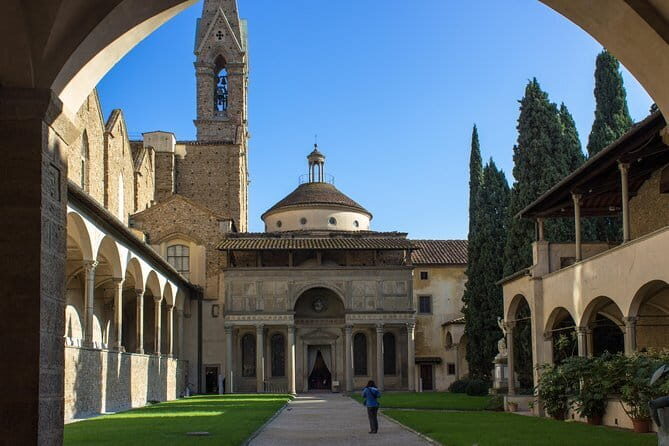
The tour ends at the Green Cloister, so you finish with a quieter, more reflective feeling than the busy square outside. The cloister’s name comes from the murals painted by Paolo Uccello using green earth tones, which is a detail your guide can point out in a way that makes it more than just pretty decoration.
Cloisters in Italy aren’t random open-air hallways. They’re designed for calm walking, small-scale gatherings, and a kind of slow learning. That’s exactly what makes this stop useful: after big altarpieces and famous names inside the basilica, the Green Cloister teaches you to look for symbols and craft.
A good guide also helps you see the logic of the space. You get a sense of how the cloister works as a bridge between sacred life and everyday rhythm within the religious community. If you’ve ever felt overwhelmed by Florence’s art density, this is a helpful reset.
San Lorenzo’s Old Sacristy and Brunelleschi’s Canons Cloister
Next you head into the Medici orbit at Basilica di San Lorenzo, one of Florence’s oldest churches. It was consecrated in 393 by Sant’Ambrogio, rebuilt in the year 1000, then expanded in 1400 at the behest of the Medici family. That sequence matters because it shows the church as both a long-standing spiritual site and a political statement.
Inside is the Old Sacristy, attributed to Brunelleschi. This is where the tour’s “power story” becomes physical: tombs tied to the Medici founders and artworks by Donatello, Bronzino, Filippo Lippi, Rosso Fiorentino, and Pontormo. That mix can be a lot in 50 minutes, but this is also where a guide earns their fee by making the big names feel connected rather than like a checklist.
Then you leave the church for the Cloister of the Canons, also designed by Brunelleschi. In the center is the orange tree, an important Medici symbol. It’s one of those details that makes the cloister feel alive—part garden, part message.
You can also read our reviews of more private tours in Florence


Why this stop is worth your time
San Lorenzo isn’t just famous because it’s old or because Brunelleschi’s name is attached. It’s famous because you can see how families used architecture and art to shape memory. When you understand that, the Medici story stops being abstract.
Practical note
Admission tickets for San Lorenzo are not included, and you pay on the spot. The adult price is listed as €6, with free admission for children younger than 11.
Piazza del Duomo and Piazza della Signoria for Medici context
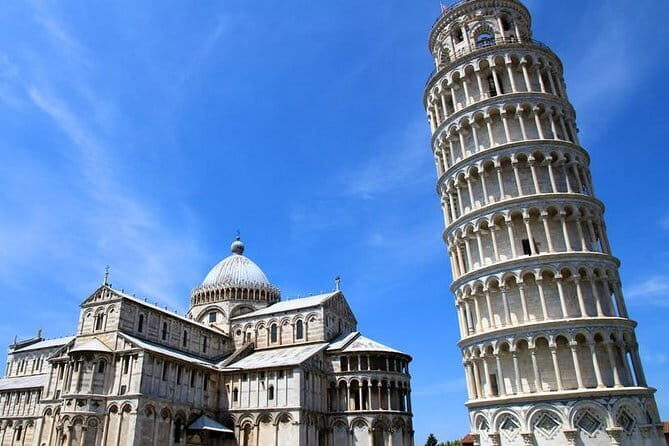
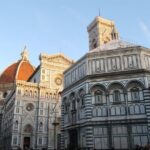
This portion moves you from interiors to the open-air stage where Florence is easiest to read. You’ll spend a brief stop in Piazza del Duomo, the city’s religious center.
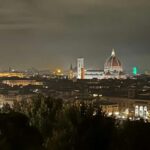
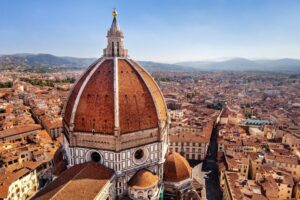
From there you admire the Cathedral with its dome, the Baptistery, and Giotto’s Campanile. The key word here is admire: the time is short and the tour is designed for sightlines and orientation rather than long interior time.
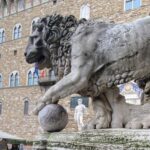
Next comes Piazza della Signoria, a concentration of architectural and sculptural masterpieces with no equal in the world, and the place where the Medici story kicks into focus. You’ll also visit the Medicis’ historical square area as part of this segment.
This quick pairing is smart. It prevents the tour from feeling like five disconnected museum stops. You see where the buildings sit in the city’s power layout, and you start connecting the art to who funded it and why.
Practical note
These steps are listed as free in terms of admission.
Santa Croce: Gothic marble, Donatello, and three legends in tomb form
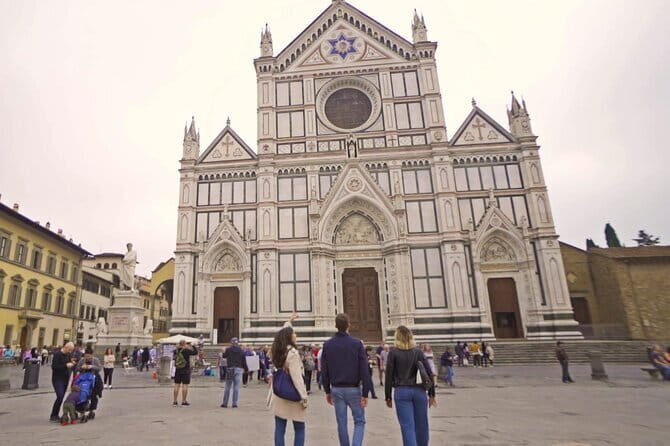
Your final stop is the Basilica of Santa Croce, and it lands with a strong “finish” feeling. The church is Gothic, with a façade clad in polychrome marble, so it looks dramatic even before you step inside.
Inside, your guide sets the scene with the Franciscan history—how the friars began treating pelts and leather and meditating in peace when the area was outside the city walls. That kind of backstory helps Santa Croce feel less like a landmark you pass and more like a place that grew with the neighborhood.
Then you get the art hits: close views of frescoes by Giotto and Agnolo Gaddi, plus Donatello’s Crucifix and Annunciation. And because Santa Croce is also a pantheon, you’ll see the funerary monuments and tombs of Michelangelo, Galileo, and Machiavelli. When you see those names in the same place, the city’s idea of legacy clicks.
Finish with Brunelleschi’s cloisters and the Pazzi Chapel
After the main church interior, the tour steps into the Brunelleschi Cloister, then into the Ancient Cloister. From there you reach the Pazzi Chapel, described as a sublime example of Renaissance harmony and also linked to Brunelleschi.
This is the kind of finale that’s great for photos and even better for understanding. You close the day with a shift from public fame (tombs) to measured design (chapel harmony), so the last impression is about craft, not just celebrity.
Practical note
Santa Croce admission is not included and is paid on the spot. The adult ticket is listed as €8.
How much time you get, and what to do next
With this tour, you’re moving on purpose. You spend about 1 hour at Santa Maria Novella, 50 minutes at San Lorenzo, and about 50 minutes at Santa Croce. That leaves only short exterior/overview time in Piazza del Duomo and Piazza della Signoria.
So if you love spending long stretches in one chapel, you’ll still want more time after the tour. But if your goal is to get the names, the symbols, and the relationships between churches quickly, this format is a strong deal.
One thing I appreciate from the guide feedback patterns here is pacing. People in their 70s have been able to keep up comfortably, and families with children have had their attention held without the tour turning into a lecture that ignores everyone’s energy. If you’re bringing kids or you want a gentler rhythm, this is a good match.
If you want to follow up afterward, think about choosing one location to return to on your own. Santa Croce is an easy “second visit” candidate because the church and its cloisters give you multiple layers. Santa Maria Novella also rewards a re-look once you know the big works your guide pointed out.
Price and tickets: where the money goes for a private basilica tour
The price is $205.47 per person for about 3 hours in a private setting. What you’re really paying for is the guide time plus a structured flow that keeps you from wasting half your day figuring out what matters.
This tour includes a local professional guide and earphones if your group is over 7. It also includes a mobile ticket and notes group discounts.
Tickets for the main interiors are not included, so budget for them. The data lists these adult prices:
- Santa Maria Novella: €7.50
- San Lorenzo: €6
- Santa Croce: €8
If you’re an adult, that’s roughly €21.50 total in basilica admissions on top of the tour price. If you’re traveling with kids, the free/discount rules listed can reduce that extra cost (for example, children younger than 11 are free for San Lorenzo, and 10 and under are free for Santa Maria Novella).
Is it value?
It tends to feel like good value if:
- you want a clear Florence overview without planning every step
- you’re interested in the art but also in what it meant at the time
- you’d rather pay for guidance than spend your limited time hunting for context
If you’re the kind of visitor who loves long, quiet self-guided wandering for hours per church, then you might feel the tour is just a taste. In that case, you could still book this for orientation, then return later.
Who this tour suits best in Florence
This tour is ideal for you if you want a compact “Florence foundation” in one morning. It hits major institutions—Santa Maria Novella, San Lorenzo, and Santa Croce—plus key city squares that explain the bigger Medici story without requiring hours of map time.
It also fits well if your group includes mixed ages. The guide style you’ll want is the kind that adjusts explanations and pacing, and the examples shared include guides who can keep older visitors comfortable and keep conversations relevant for children too.
Where it may not be the best fit:
- If you need to spend lots of time sitting with frescoes, this tour’s time slots are short.
- If you’re okay with doing Florence mostly on your own, you might prefer a self-guided route with just one paid entry guide.
Should you book this private Florence basilicas and cloisters tour?
I think you should book it if you want structure, context, and access to the art stories that make Florence feel coherent. The private guide, the cloister focus, and the way the stops trace Medici influence are exactly the ingredients that help a first visit land smoothly.
It’s also a smart pick if you can’t afford to burn hours on logistics. Meeting outside Santa Maria Novella and ending inside Santa Croce means you don’t feel stuck in transit while other cities’ highlights pass you by.
If you’ve got plenty of time and you want deep chapel-by-chapel study, book a longer art-focused option instead. But for most people doing Florence as a short trip, this is a clean, high-impact path.
FAQ
What’s the duration of the tour?
The tour lasts about 3 hours.
What language is the tour offered in?
The tour is offered in English.
Is this tour private?
Yes. It’s a private tour/activity, and only your group will participate.
Where do you meet, and where does the tour end?
You meet at Basilica of Santa Maria Novella, P.za di Santa Maria Novella, 18, 50123 Firenze FI, Italy. The tour ends at Basilica of Santa Croce in Florence, Piazza di Santa Croce, 16, 50122 Firenze FI, Italy.
Are the basilica admission tickets included in the price?
No. Santa Maria Novella, San Lorenzo, and Santa Croce admissions are not included, and you pay those tickets separately (Santa Maria Novella and San Lorenzo on the provided ticket list; Santa Croce is paid on the spot).
Does the tour include earphones?
Earphones are included for groups of more than 7 participants.
Can I cancel for a full refund?
Yes. You can cancel for free up to 24 hours in advance of the experience for a full refund.
You Might Also Enjoy
More Guided Tours in Florence
- The Best tour in Florence: Renaissance & Medici Tales – guided by a STORYTELLER
★ 5.0 · 12,316 reviews
More Tours in Florence
- The Best tour in Florence: Renaissance & Medici Tales – guided by a STORYTELLER
★ 5.0 · 12,316 reviews
More Tour Reviews in Florence
- Tuscany Day Trip from Florence: Siena, San Gimignano, Pisa and Lunch at a Winery
★ 5.0 · 21,634 reviews - The Best tour in Florence: Renaissance & Medici Tales – guided by a STORYTELLER
★ 5.0 · 12,316 reviews