REVIEW · FLORENCE
The Best of Florence Walking Tour in a Small Group
Book on Viator →Operated by All Around Florence · Bookable on Viator
Florence makes more sense when you walk it. This small-group tour stitches together the Medici power story and the city’s biggest icons—Duomo, Piazza della Signoria, and Ponte Vecchio—so you understand what you’re looking at, not just where it is.
I love the group size capped at 15 and the whisper system, which keeps you hearing the guide clearly even when the crowds press in. I also like that your guide points out what to notice and shares trip-friendly recommendations for things to do and places to eat while you’re here.
The one drawback to plan for: admission isn’t included for most stops, so you may want to budget extra if you want to go inside a few of the major sights.
In This Review
- Key highlights you’ll feel on the walk
- Why this 1 hour 45 minute Florence walk is such good value
- Meet at Caffè Scudieri: the small-group format actually helps
- Medici Florence: San Lorenzo, the Laurentian Library, and the Chapels
- The Duomo complex: Gothic beginnings, Romanesque stone, and Brunelleschi’s dome
- Piazza della Signoria and Palazzo Vecchio: where politics becomes art
- Ponte Vecchio and Palazzo Pitti: the Arno’s most famous frontage
- Tickets and the one cost trap to watch
- What your guide style can change (Manuel, Camilla, Simona, and more)
- Timing, weather, and how to plan your day
- Practical tips so the walk feels easy, not annoying
- Who should book this Florence highlights walk
- Should you book this tour?
- FAQ
- How long is the Florence walking tour?
- What does it cost?
- What is the group size?
- What language is the tour offered in?
- Where do we meet and where does it end?
- What time does the tour start?
- Are admission tickets included for the sights?
- Do we get any help hearing the guide?
- What if the tour is canceled due to weather or low participation?
Key highlights you’ll feel on the walk
- Small-group cap (max 15) for a more personal pace through tight streets
- Licensed local guide who can explain what you’re seeing in plain language
- Whisper/ear-piece system so you can hear without constantly craning your neck
- Medici-focused route from San Lorenzo and the Laurentian Library to the Medici Chapels
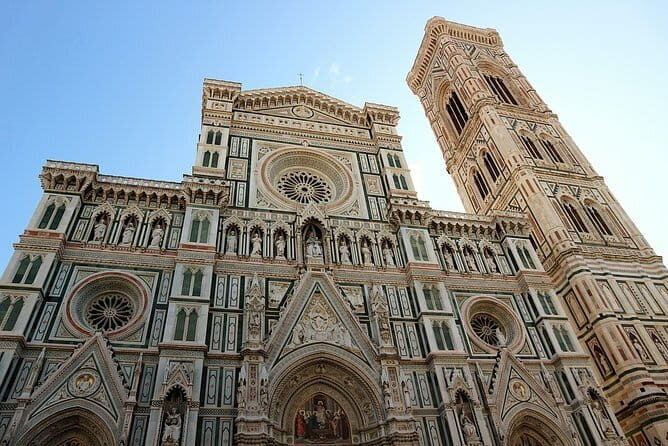
- Duomo complex at street level with stops around the Baptistery, Campanile, and Brunelleschi’s dome
- Old bridge payoff at the end with Ponte Vecchio in view before you keep exploring
Why this 1 hour 45 minute Florence walk is such good value
If you only have a day or two in Florence, you need orientation fast. This tour is built for that. In about 1 hour 45 minutes, you get a guided pass through the city center’s most important cultural hubs—especially the Medici world that shaped Florence’s art and architecture.
At $59.26 per person, the price feels fair because you’re paying for two things that are hard to replicate on your own: a well-structured route and a guide who can explain why each place matters. Many of the stops are short from a physical time standpoint, but they’re long on context—exactly what you want when you’re trying to avoid feeling lost among the statues, churches, and palaces.
The tour also makes a practical promise: you slow down and explore on foot, instead of rushing from one entrance line to the next. That changes the whole experience. You’re not just ticking off landmarks; you’re learning the city’s logic while you walk it.
You can also read our reviews of more walking tours in Florence

Meet at Caffè Scudieri: the small-group format actually helps
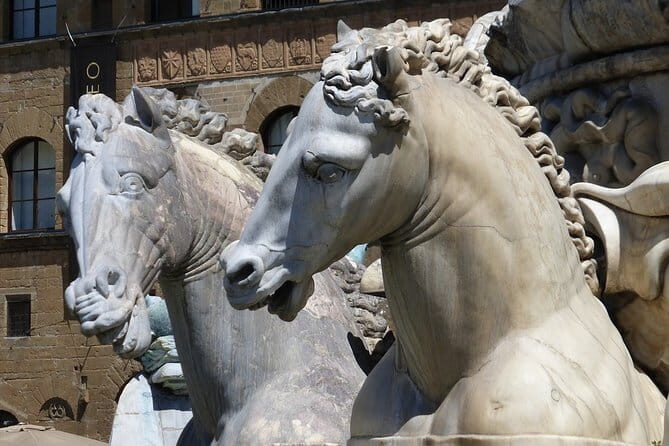
You start near Piazza di San Giovanni, at Caffè Scudieri Firenze, and you finish around Ponte Vecchio. That matters because you’re walking a loop through the historic center’s core, with the Arno and its landmarks feeding into your final stretch.
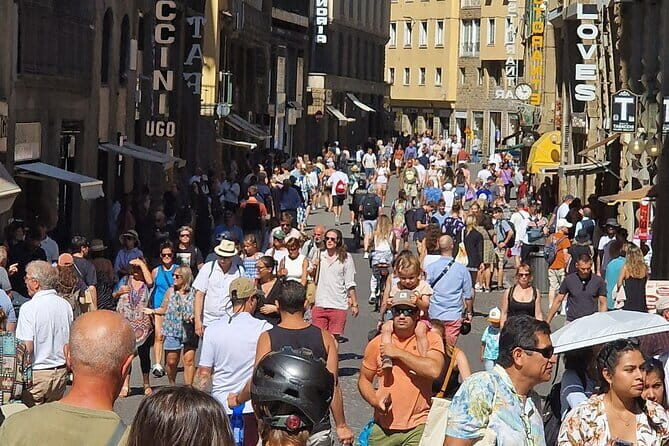
The best part is the maximum of 15 travelers. Smaller groups mean less time waiting and more chance to ask a question. It also makes the pace feel human. You don’t get swept along like you’re in a human conveyor belt.
And then there’s the sound setup: this tour uses a whisper system. In real-life terms, it means you’ll hear the guide’s explanations without constantly straining. It’s a big deal in Florence, where churches and squares can make sound bounce around and crowds can swallow voices.
I also like that the tour is offered in English, and you get a mobile ticket. If you’re trying to travel light and keep things simple, that’s a real convenience.
Medici Florence: San Lorenzo, the Laurentian Library, and the Chapels
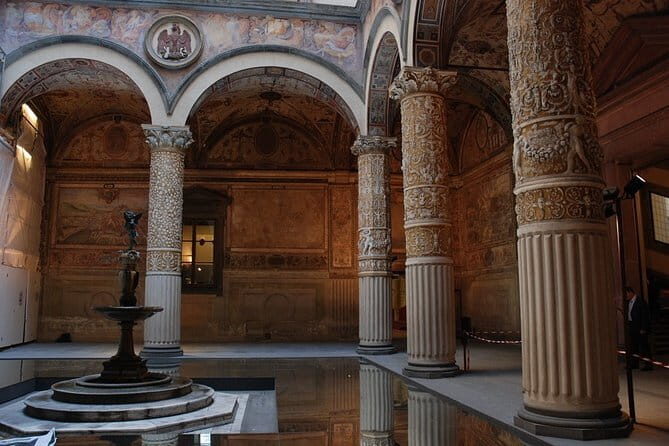
This tour leans hard into the Medici story, and that’s smart. Florence’s art isn’t random; it’s tied to who funded it and why. You feel that connection from the first stops.
Basilica di San Lorenzo is where the guide starts you off in the center of Florence’s main market district. This church isn’t just famous for its scale—it’s also the burial place of principal Medici family members, from Cosimo il Vecchio to Cosimo III. That detail gives you a clearer sense of why the Medici had such gravity in civic and religious life.
Next is the Biblioteca Medicea Laurenziana. The point here is not just that it’s old. It’s that it was built through the patronage of Medici pope Clement VII, with a message: the Medici were no longer only merchants. They wanted to be seen as part of the intellectual and ecclesiastical world too. You’ll also hear about its connection to Michelangelo’s architectural design and the Mannerism style—useful context when you’re looking at the forms and feeling that they don’t always behave like straightforward Renaissance geometry.
Then you hit the Cappelle Medicee, including the Sagrestia Nuova designed by Michelangelo. These chapels were built as extensions to Brunelleschi’s 15th-century church, with the purpose of celebrating Medici power. If you’ve ever wondered why Florence is obsessed with grand family narratives, this is where you see the design logic applied to politics and legacy.
Why these stops work even when they’re brief: the exterior views and quick explanations help you understand the roles—church as family monument, library as status signal, chapel as artistic statement—without forcing you to commit to long museum sessions early on.
The Duomo complex: Gothic beginnings, Romanesque stone, and Brunelleschi’s dome
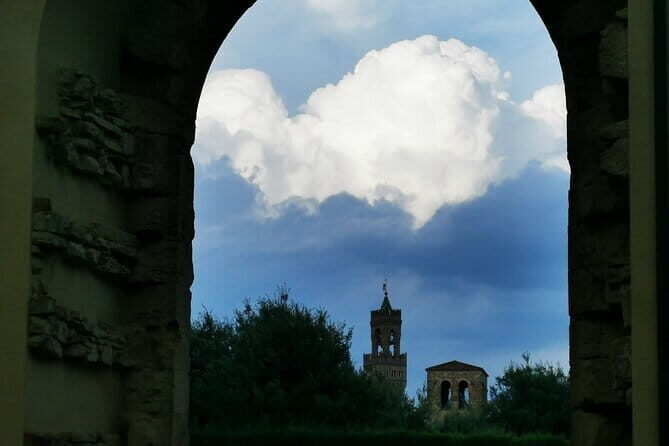
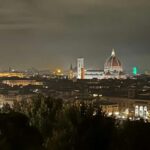
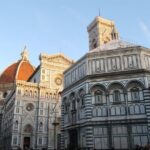
Then the route shifts into the religious and architectural rock star section of Florence: the Duomo complex area. Even if you’ve seen photos before, being there in person gives you a better read of scale and placement—how the Cathedral, Baptistery, and Campanile act like a trio around the square.
You’ll see the Cattedrale di Santa Maria del Fiore, a cathedral that started in 1296 in Gothic style, designed by Arnolfo di Cambio. This is the kind of fact that changes how you look at the façade colors and the overall structure—suddenly it’s not just pretty marble, it’s a timeline you can sense.
The tour then points you across to the Battistero di San Giovanni. The Baptistery is one of the oldest buildings in Florence, constructed between 1059 and 1128 in Florentine Romanesque style. That time depth is a useful contrast after you’ve been thinking about Medici-era artwork. Florence layers eras without asking permission.
Next comes the Cupola del Brunelleschi. You’ll hear why it’s famous: the dome is described as the largest brick dome ever constructed, and it was the largest in the world when it was built. This is one of those details that turns the stop from sightseeing into real architecture curiosity.
Finally, you’ll also be at Campanile di Giotto—adjacent to the Cathedral and Baptistery. It’s known for rich sculptural decoration and polychrome marble encrustations, with design by Giotto. If you like reading architecture like a text, this is a great moment to slow down and notice the surfaces.
Small note: some of these are ticketed experiences if you want to go inside. But even from outside, the guide’s explanations help you avoid the common mistake of treating them like separate attractions instead of one connected complex.
Piazza della Signoria and Palazzo Vecchio: where politics becomes art
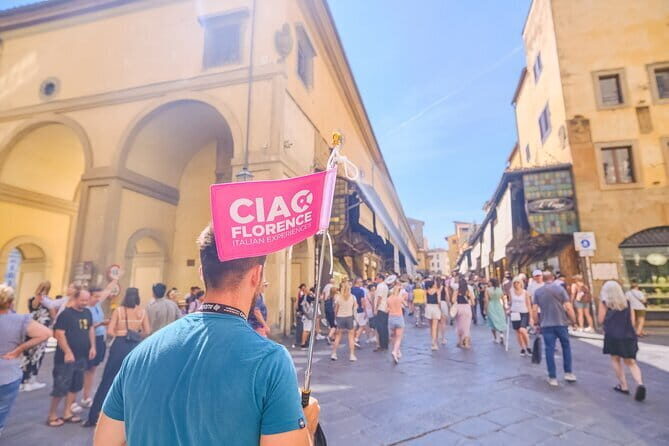
Once you move out of the Duomo square orbit, the tour takes you into Piazza della Signoria, a lively, L-shaped square directly in front of Palazzo Vecchio. This is the kind of public space Florentines have used for gatherings, and it’s also a gateway area—right near the Uffizi.
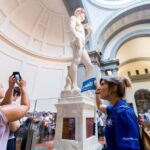
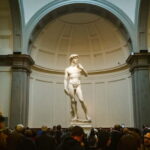
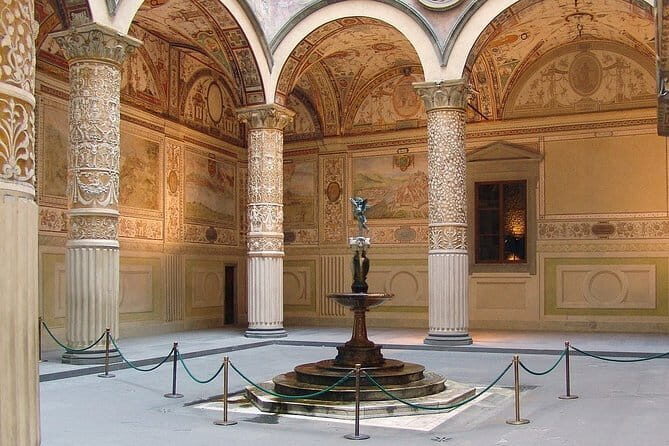
You’ll then see Palazzo Vecchio, the city’s town hall, described as a massive fortress-palace. This is one of those places where the exterior alone tells a story about power. The square viewpoint also connects you to the sculptural scene through the copy of Michelangelo’s David nearby and the presence of statues in the Loggia dei Lanzi.
After that, the walk brings you to the Gallerie Degli Uffizi area. The Uffizi is presented as a major Renaissance museum and a huge deal in art-world terms. You’ll also learn that the complex originally began under Giorgio Vasari in 1560 to house offices of Florentine magistrates for Cosimo I de’ Medici—the name relates to those offices (uffizi).
How to use this stop well: if you’re planning to visit Uffizi later, this guide moment helps you get your mental map straight. It also helps you understand why the building sits exactly where it does—government offices and art institutions share a long history in Florence.
- Tuscany Day Trip from Florence: Siena, San Gimignano, Pisa and Lunch at a Winery
★ 5.0 · 21,634 reviews

Ponte Vecchio and Palazzo Pitti: the Arno’s most famous frontage
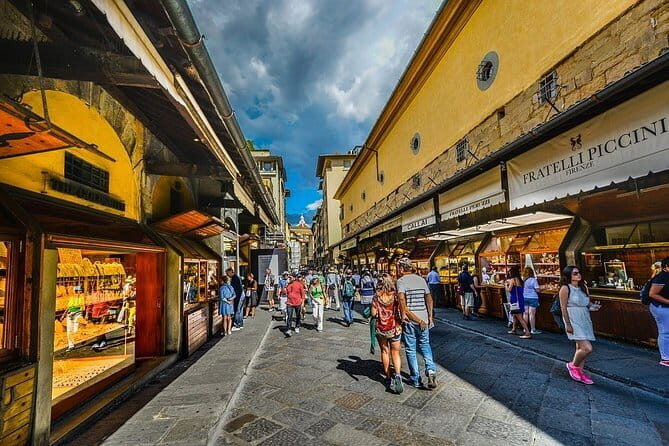
The walk ends with a satisfying Florence photo-and-story finish: Ponte Vecchio. The guide frames it as the oldest bridge over the Arno River in Florence, and the key detail is the shops along the bridge.
Historically, the shops were tied to trades like butchers, tanners, and farmers. Over time, the tenancy shifted, and today the bridge is known for jewelers and art dealers. That trade evolution is a small detail, but it makes the bridge feel alive as a long-running business street, not just a scenic crossing.
Then, with the route still in your brain, you’ll see the direction of Palazzo Pitti. This palace was bought by the Medici in 1549 and became the chief residence of the ruling families of the Grand Duchy of Tuscany. It grew as a major treasure house, with later generations adding collections like paintings and luxury possessions.
Why ending near Ponte Vecchio is smart: it gives you a natural next step. After the guide’s walking explanations, you can keep going on your own along the riverfront area and decide what you want to see deeper without feeling pressured.
Tickets and the one cost trap to watch
Most of the stops are listed as admission not included, which is typical for short walking tours. In other words: you’ll get guided explanations and views, but if you want to enter certain buildings, you’ll likely pay extra.
One place that’s marked free in the tour schedule is the Duomo area (Cattedrale di Santa Maria del Fiore). Other major sights—like the Laurentian Library, Medici Chapels, the Baptistery, the dome experience, and major museums—are not included.
Here’s how I’d handle it so you don’t get surprised: before you go, decide which two “inside” experiences are most worth your money and time. Everything else becomes a guided look from the outside. That keeps this tour feeling like an affordable orientation, instead of a bundle of extra fees.
What your guide style can change (Manuel, Camilla, Simona, and more)
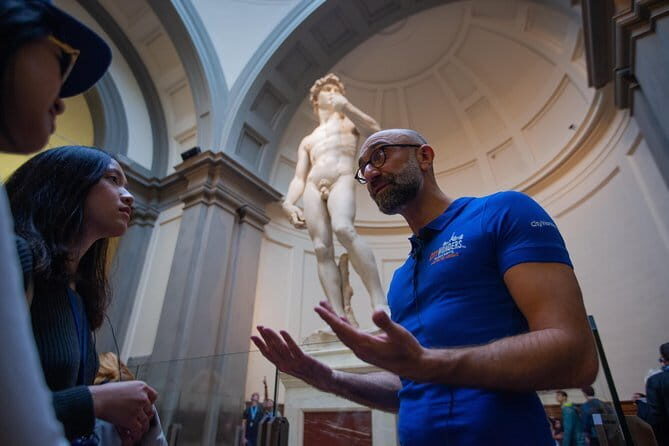
One reason this walking tour gets such high marks is the human factor. You’ll be with a licensed guide, and the tone in the explanations tends to feel story-driven and practical.
Names you might hear include Manuel, Camilla, Simona, and Julio—and different guides bring different strengths. Some focus on keeping the architecture understandable. Others mix in humor. Many also call out details you might miss on your own, like specific things to watch for on façades and in the way buildings sit in the square.
It’s also built for real conversation because of that 15-person cap. If you want recommendations for what to eat nearby or what to look for as you walk, you’ll usually have time to get an answer.
Timing, weather, and how to plan your day
The start time is 12:15 pm, and the tour runs about 1 hour 45 minutes. That makes it a good midday anchor if you’re already in the center and want to reset your bearings afterward.
This experience requires good weather. If it’s canceled due to poor conditions, you’ll be offered a different date or a full refund. So it’s worth building in a little flexibility on your schedule if you can.
Also, it’s a tour that’s commonly booked ahead. The average booking window is about 59 days in advance, so if your dates are fixed, don’t wait until the last week.
Practical tips so the walk feels easy, not annoying
Florence walking can be great—or rough—depending on your setup. Here’s how I’d prepare.
- Wear comfortable shoes. You’re moving between major sites with short stop times, and you’ll want solid footing on stone streets.
- Bring a phone-charged battery for the mobile ticket and for later directions if you branch off after the tour ends.
- Use the ear pieces fully. The whisper system only works if you keep it in place and don’t take one side out.
- Keep an eye on shade. Church fronts and squares can be sun-heavy; good guides typically manage the flow so you’re not stuck in full exposure the whole time.
If you’re the type who likes to understand how cities worked—who paid for what, why the buildings are arranged the way they are—this tour is a strong use of your time.
Who should book this Florence highlights walk
This tour is a great fit if:
- you’re visiting Florence for the first time and want a fast, coherent overview
- you care about the Medici influence on art and architecture
- you want a guided walk that connects big landmarks into one story
- you prefer a small group over large bus tours
It’s also a smart choice if you’re short on time. You’ll see the major anchors—Duomo complex, Piazza della Signoria, Uffizi area, Ponte Vecchio—then you can decide which ticketed experiences are worth adding next.
Should you book this tour?
Yes, if you want a clear Florence roadmap with a human guide and you’re okay paying separate admission for some sights. The format is efficient, the sound setup is practical, and the Medici-to-Duomo-to-Arno route gives you context you’ll feel all day.
I’d skip it only if you already have a detailed plan for every major interior and prefer to self-guide without group pacing. In that case, you might feel the time spent at some stops is better used elsewhere.
FAQ
How long is the Florence walking tour?
It runs for approximately 1 hour 45 minutes.
What does it cost?
The price is $59.26 per person.
What is the group size?
The tour has a maximum of 15 travelers.
What language is the tour offered in?
It’s offered in English.
Where do we meet and where does it end?
You start at Caffè Scudieri Firenze, Piazza di San Giovanni, 19R, 50123 Firenze FI, Italy. The tour ends in the Ponte Vecchio area (the exact end point can vary slightly within the area).
What time does the tour start?
The start time is 12:15 pm.
Are admission tickets included for the sights?
Admission is not included for most stops. The Duomo/Cattedrale di Santa Maria del Fiore is marked as free in the tour schedule, while other major sites are listed as ticketed.
Do we get any help hearing the guide?
Yes. The tour includes a whisper system, so you can hear the licensed guide clearly.
What if the tour is canceled due to weather or low participation?
If the tour is canceled due to poor weather, you’ll be offered a different date or a full refund. If it’s canceled because the minimum traveler requirement isn’t met, you’ll also be offered a different experience/date or a full refund.
You Might Also Enjoy
More Walking Tours in Florence
More Tours in Florence
- The Best tour in Florence: Renaissance & Medici Tales – guided by a STORYTELLER
★ 5.0 · 12,316 reviews

More Tour Reviews in Florence
- Tuscany Day Trip from Florence: Siena, San Gimignano, Pisa and Lunch at a Winery
★ 5.0 · 21,634 reviews - The Best tour in Florence: Renaissance & Medici Tales – guided by a STORYTELLER
★ 5.0 · 12,316 reviews