REVIEW · FLORENCE
Florence: Uffizi Gallery Small-Group Guided Tour with Ticket
Book on GetYourGuide →Operated by THINGS TO DO IN · Bookable on GetYourGuide
Uffizi hits different with a guide. This small-group, 1.5-hour Florence tour uses priority entrance and headsets so you can focus on the art instead of wrestling the lines. You’ll be guided through major Renaissance-to-Baroque highlights, with standouts like Botticelli, Leonardo da Vinci, and Michelangelo.
What I like most is the way you get the best-known works without feeling lost in a museum maze. You’ll hit headline paintings and sculptures such as Birth of Venus, Primavera, Leonardo’s Annunciation, and Michelangelo’s Tondo Doni—plus supporting details along the way. Second, you can actually ask questions; several guides named in the experience feedback (like Pam, Anna, Vicky, and Olga) are praised for turning the gallery into a clear story you can follow.
One drawback to plan for: 1.5 hours is still short for the scale of the Uffizi. This tour selects key stops, so you won’t see everything, and if you want a full-by-room pass, you’ll need extra time after the tour (or a longer format).
In This Review
- Key highlights at a glance
- Uffizi in 90 minutes: why this small-group format makes sense
- Meet at Nicola Pisano: quick start, then straight into the museum
- Priority entrance: skipping the ticket line without skipping the story
- Botticelli’s myth world: Birth of Venus and Primavera
- Leonardo’s Annunciation: when details do the talking
- Michelangelo at the center: Tondo Doni and artistic evolution
- A guide who manages crowds without turning your day into a sprint
- Itinerary flow: from orientation stop to ending inside the gallery
- Price and value: what you’re really paying for at $76
- Who should book this Uffizi tour?
- Should you book the Uffizi small-group guided tour?
- FAQ
- How long is the Uffizi Gallery small-group guided tour?
- Where do I meet the guide?
- Does this tour include Uffizi admission?
- Is there priority entrance or a skip-the-line option?
- Will I be able to hear the guide clearly?
- What languages are offered for the live guide?
- Is the tour wheelchair accessible?
- What should I bring?
- What’s not allowed during the visit?
- Can I cancel or pay later?
Key highlights at a glance
- Skip-the-line entry: priority entrance helps you avoid the longest waits.
- Headsets included: you hear the guide clearly even in busy rooms.
- Big names, real context: Birth of Venus, Primavera, Annunciation, Tondo Doni.
- Small-group pacing: more questions, less rushing, less “look and run.”
- A guide who explains the why: stories and symbolism, not just titles and dates.
- You still get solo time after: the tour ends at the gallery, so you can return to favorites.
Uffizi in 90 minutes: why this small-group format makes sense
Let’s be honest: the Uffizi is famous, and that also means it can be a zoo. This tour is built around a practical goal—get you to the points that matter most, with context you’ll remember later, in a set time window.
For $76 per person, you’re paying for three things at once: your entry ticket, a live guide for 1.5 hours, and the setup that helps you hear and enter faster (headsets and priority entrance). If you’re coming to Florence with limited time—or you simply don’t want to spend your best hours stuck behind other people—this format can be good value.
The small-group size is a quiet advantage. It keeps your guide moving at a human pace and gives you space to ask questions. In the feedback, guides like Pam, Irina, Anna, and Vittoria are repeatedly described as patient and energetic, and that matters in a museum where standing still is often the only option.
You can also read our reviews of more tours and experiences in Florence

Meet at Nicola Pisano: quick start, then straight into the museum
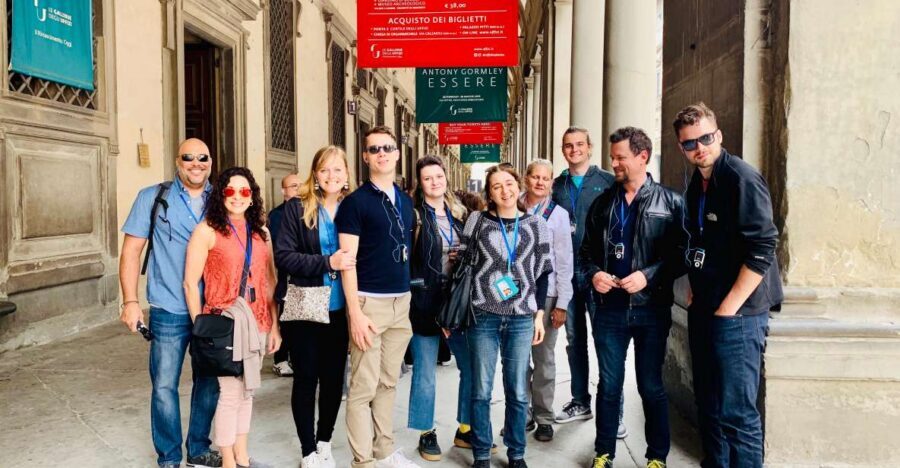
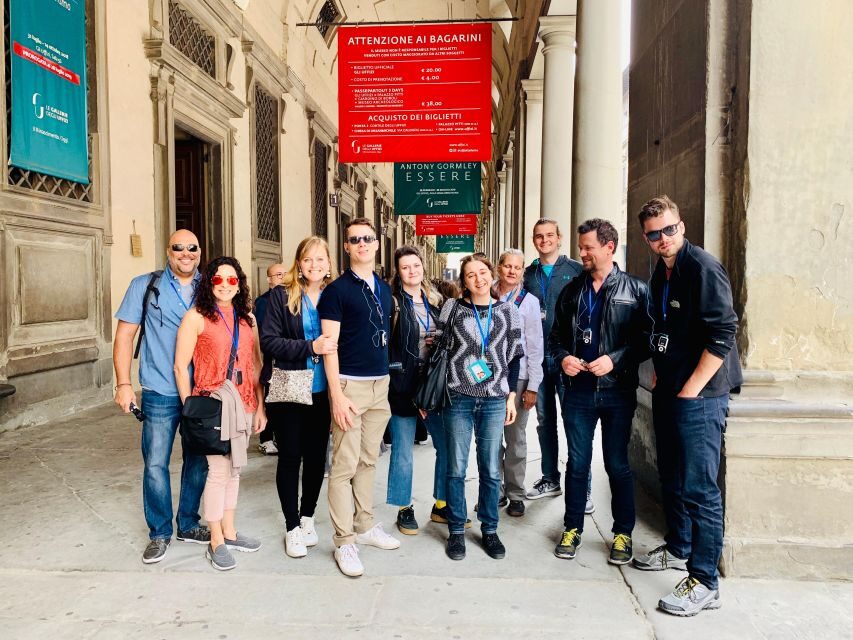
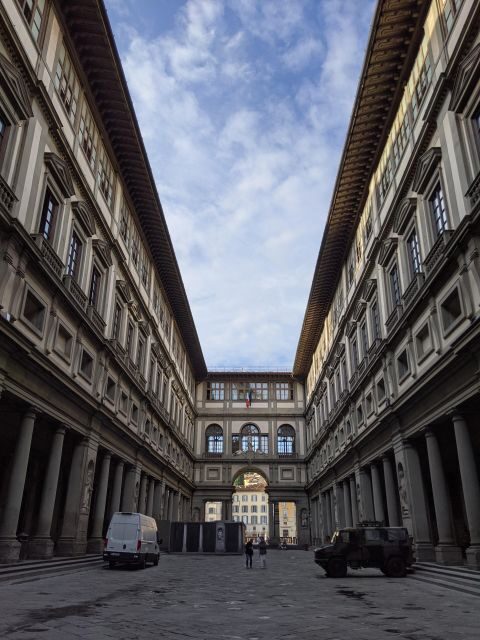
Your tour meets outside at the Statue of Nicola Pisano, Piazzale Degli Uffizi, 6, close to the Uffizi info point. Plan to arrive about 15 minutes early. That buffer helps you find the group, get your bearings, and avoid the panic that comes from the Uffizi area being… well, busy.
Before you enter, everyone goes through a metal detector. If you’re carrying anything bulky, you’ll want to be ready to manage it quickly. It’s also worth knowing that flash photography is not allowed inside, and oversize luggage isn’t permitted.
Also, the tour is wheelchair accessible, and the guide includes headsets, so even if you’re in a crowded room, you can still follow along without craning your neck.
Priority entrance: skipping the ticket line without skipping the story
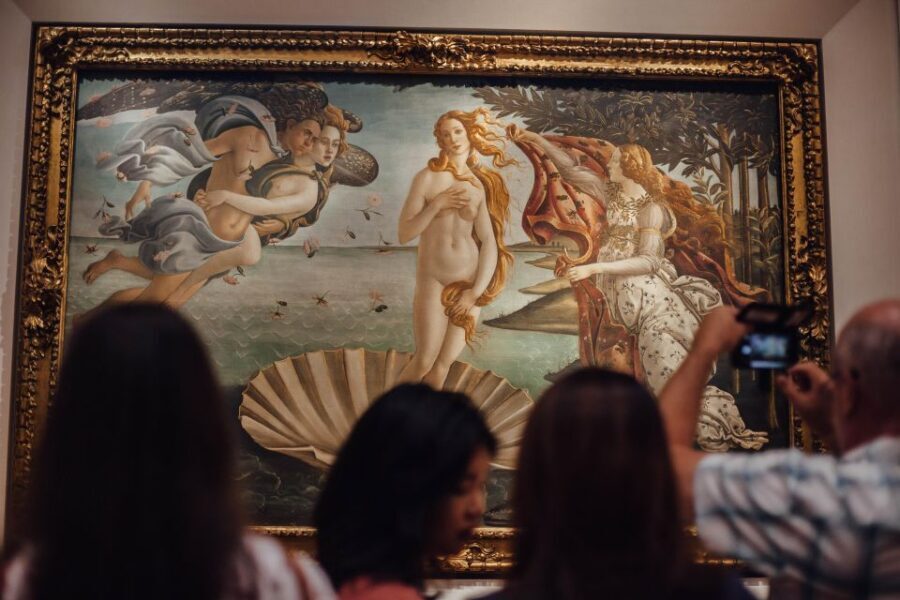
The big win here is not just speed—it’s time quality. When you skip the ticket line, you spend less time waiting and more time actually looking. One tip that came up in the experience feedback: guides often keep the tour moving with smart choices when crowds are heavy, so you don’t lose the hour to bottlenecks.
Once inside, the guide typically sets the stage fast—Florence, the Medici world, and why these artists mattered—before pointing you to specific masterpieces. In the feedback, a guide named Bruce is praised for starting with background on the Medici and the collections, then using short stops and explanations to make the building and its contents click.
You’ll wear headsets for the guided portion. This is one of those “small detail, big payoff” things, because the Uffizi is loud in the way only a major museum can be. Being able to hear your guide clearly makes a real difference when you want to understand what you’re seeing, not just glance at it.
Botticelli’s myth world: Birth of Venus and Primavera
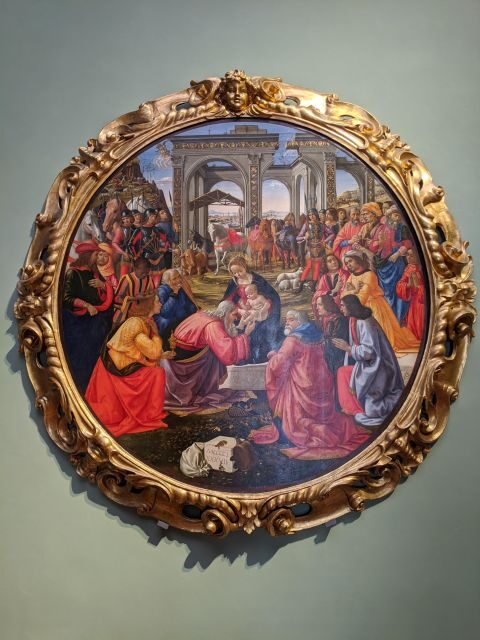
If you’re building a Florence trip around recognition, Botticelli is the hook. This tour aims you toward his most famous myth works and explains why they’re more than beautiful images.
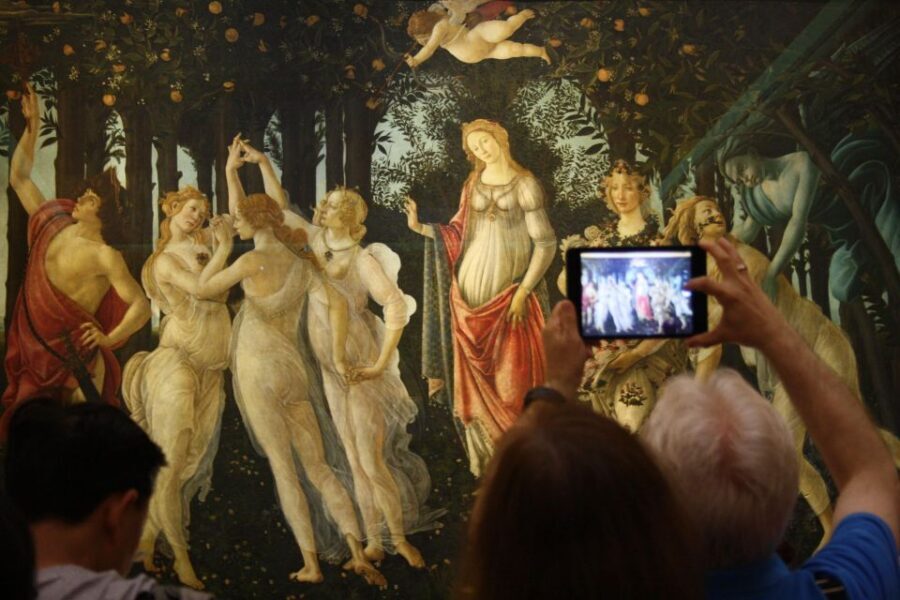
You’ll see Birth of Venus—the kind of painting that pulls people in even if they claim they’re not art people. The guide’s job is to help you notice the details that make it meaningful: the symbolism, the story behind the figures, and the cultural “why” of what’s shown.
You’ll also have Primavera on your path. This is the painting where the names and the meanings can feel like alphabet soup if you just look at it alone. With a live guide, you get a framework for what to look for, so you aren’t left standing there wondering what you’re supposed to “get.”
In the feedback, guides such as Anna and Vicky are praised for focusing on the important works and not rushing through them. That matches what you want here. These Botticelli pieces deserve a slow look, and a guided pace can protect that moment from turning into a 30-second photo sprint.
Leonardo’s Annunciation: when details do the talking
Leonardo da Vinci’s Annunciation is often talked about for its mood, but the real value of a guided visit is how you’re taught to read the painting.
This tour includes Leonardo’s Annunciation, with a guide who points out the specifics that shift it from “famous” to “understandable.” You might be guided toward how the composition is built, what the figures are doing, and what those choices communicate.
A practical benefit: in a room packed with people, you don’t always get the chance to step back far enough to understand the structure of a scene. A good guide helps you decide where to stand and what to focus on first. That’s how you end up leaving with new “aha” moments instead of just a memory of faces and clothing.
In the experience feedback, guides are repeatedly described as making the art feel accessible, even when you don’t come in with art-history vocabulary. That’s exactly what you want in the Uffizi. If you’re new, the guide becomes your translator.
You can also read our reviews of more guided tours in Florence
- The Best tour in Florence: Renaissance & Medici Tales – guided by a STORYTELLER
★ 5.0 · 12,316 reviews

Michelangelo at the center: Tondo Doni and artistic evolution
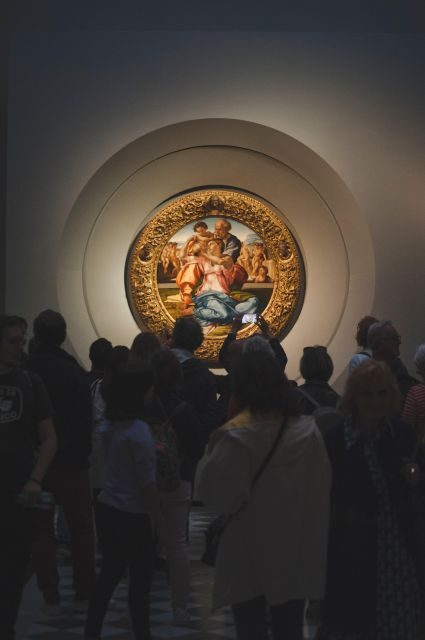
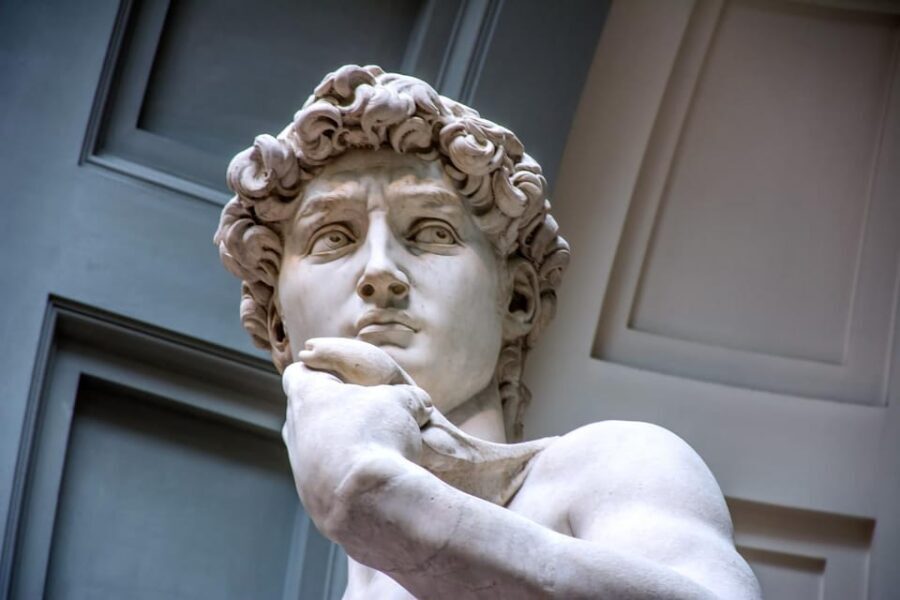
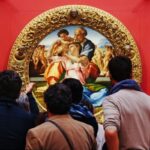
Michelangelo’s Tondo Doni shows up on this tour, and it’s a smart choice for several reasons. First, it signals the shift toward a different kind of power in art. Second, it connects painting to the bigger idea of how Renaissance artists were thinking—about form, body, and presence.
One detail that came up in the feedback from a guide named Stephen: he used examples to explain how artists approached their craft, including notes about how Michelangelo’s use of color and shape can affect the feeling of a work. That’s the kind of interpretation you can actually use while looking—because it gives you a reason to notice.
Also, many guides in the feedback are praised for explaining style progression over time. You’ll likely hear connections between the medieval roots of Italian painting and how Renaissance ideas matured. Even if you only catch some of it, it makes the Uffizi feel less like separate masterpieces and more like a timeline.
A guide who manages crowds without turning your day into a sprint
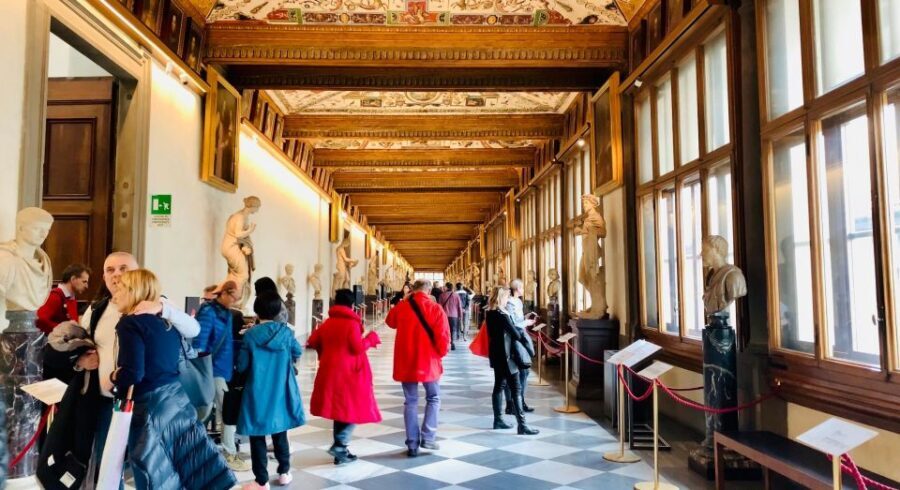
The Uffizi crowd is real. Priority entrance helps, but you’re still walking through a museum with thousands of people trying to do the same thing at once.
This is where the guide’s technique matters. In the feedback, guides like Deborah and Leticia are praised for smart pacing—stopping long enough to make meaning, but also moving when rooms get packed. Some guides are even singled out for handling it with humor or confidence, which is useful when the setting itself can feel chaotic.
You’ll also notice the tour is selective by design. That’s not a flaw—it’s the point. Multiple guides are praised for helping groups avoid overwhelm by focusing on the main attractions and the building blocks of the collection. If you try to “see it all” on your own, you end up seeing nothing clearly.
One more practical note from the feedback: guides sometimes include small breaks while moving through the galleries. And if someone in your group has mobility needs, one guide named Gaetano is specifically praised for helping with access and pace. While your exact route can vary, it signals that your guide is meant to keep the experience workable for real people.
Itinerary flow: from orientation stop to ending inside the gallery
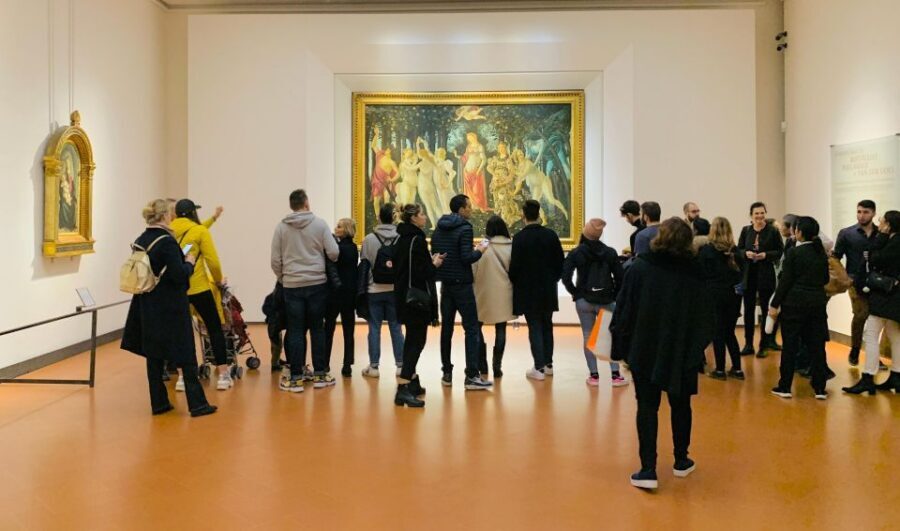
The tour is simple in structure—three steps, one big experience.
Start: You begin at the Nicola Pisano statue, then transition into the museum area with your guide. This is often when the guide gives you the big picture: Florence, the Medici circle, and how the Uffizi collection became what it is. It’s also when you get set up with the headsets.
Main stop: Inside the Uffizi, the guided portion lasts about 1.5 hours. You’ll move through key rooms and focus on highlighted masterpieces—Botticelli, Leonardo, Michelangelo, plus sculptures and other works in the collection. You’ll have time for questions, and the guide keeps you pointed at the moments that usually get missed when you wander alone.
Finish: The tour ends at the Uffizi Gallery. You’ll still be in the museum, which is a gift. The Uffizi is too large to finish in one guided loop, so use the extra time to go back to the works you liked best. Many visitors do this kind of two-stage approach: guided highlights first, then slow personal looking.
Price and value: what you’re really paying for at $76
Let’s talk money without pretending it’s magic. At $76, you’re not just buying entry. You’re buying three time-savers:
- Your ticket is included (entry to the Uffizi).
- You get priority entrance, which cuts down the biggest daily headache: the line.
- You get a live guide plus headsets, which makes the experience easier to follow and more satisfying than trying to parse everything alone.
If you’re the type who likes art but hates feeling overwhelmed, this price can feel fair fast. The tour helps you choose where to look and what to notice. That’s especially valuable here because the Uffizi’s scale is intimidating, and even with guidebooks, you can spend your time getting “facted” instead of truly looking.
If you’re the type who wants every room and every artwork, then $76 for 1.5 hours won’t cover your needs—you’ll likely want either a longer tour or separate time to explore after.
Who should book this Uffizi tour?
Book this tour if:
- You want high-impact masterpieces in a short visit.
- You’d rather ask questions than figure out meaning from signage.
- You’re visiting Florence and want a smooth museum experience that doesn’t drain your energy.
- You value clear guidance and a steady pace over a wandering self-guided approach.
Skip (or plan extra time) if:
- You’re aiming for a complete, room-by-room survey of the entire collection.
- You want to spend hours only on one artist or one gallery type, with zero schedule.
In most cases, this tour fits best as the start of your Uffizi day. Do the guided highlights, then return to your favorites and let your eyes slow down.
Should you book the Uffizi small-group guided tour?
Yes—if you’re coming to the Uffizi for the big names and you want the paintings to make sense, this is a smart use of time. Priority entrance plus headsets means less friction. The small-group format means you can ask questions instead of just holding your place in a crowd.
But be honest about expectations: 1.5 hours is highlights, not everything. If you treat it like a fast, guided launchpad—then plan time to explore on your own afterward—you’ll likely feel like you got your money’s worth and, more importantly, you’ll leave with a stronger understanding of what you saw.
FAQ
How long is the Uffizi Gallery small-group guided tour?
The tour runs for about 1.5 hours.
Where do I meet the guide?
Meet in front of the Statue of Nicola Pisano, Piazzale Degli Uffizi, 6, 50122 Florence, close to the Uffizi info point.
Does this tour include Uffizi admission?
Yes. Entry tickets to the Uffizi Gallery are included.
Is there priority entrance or a skip-the-line option?
Yes. The tour includes priority entrance and helps you skip the ticket line.
Will I be able to hear the guide clearly?
Yes. Headsets are provided so you can hear the guide.
What languages are offered for the live guide?
Portuguese, Spanish, English, French, Italian, German, and Russian.
Is the tour wheelchair accessible?
Yes, it is wheelchair accessible.
What should I bring?
You should bring a passport or ID card for children.
What’s not allowed during the visit?
Flash photography is not allowed, and oversize luggage is not permitted. Weapons or sharp objects are also not allowed. Food and drinks are not allowed in the vehicle.
Can I cancel or pay later?
You can cancel up to 24 hours in advance for a full refund, and there is a reserve now & pay later option.
You Might Also Enjoy

More Tickets in Florence


More Tours in Florence
- The Best tour in Florence: Renaissance & Medici Tales – guided by a STORYTELLER
★ 5.0 · 12,316 reviews


More Tour Reviews in Florence
- Tuscany Day Trip from Florence: Siena, San Gimignano, Pisa and Lunch at a Winery
★ 5.0 · 21,634 reviews - The Best tour in Florence: Renaissance & Medici Tales – guided by a STORYTELLER
★ 5.0 · 12,316 reviews